



Why the U Visa to Green Card Path Matters for Crime Victims
From U visa to green card is not just a legal process; it is a clear, step-by-step path that turns temporary safety into permanent security for immigrant crime victims. The U visa was designed so that people who suffer serious crimes can help law enforcement without fearing deportation. It offers temporary legal status, work authorization, and, importantly, a route to lawful permanent residence.
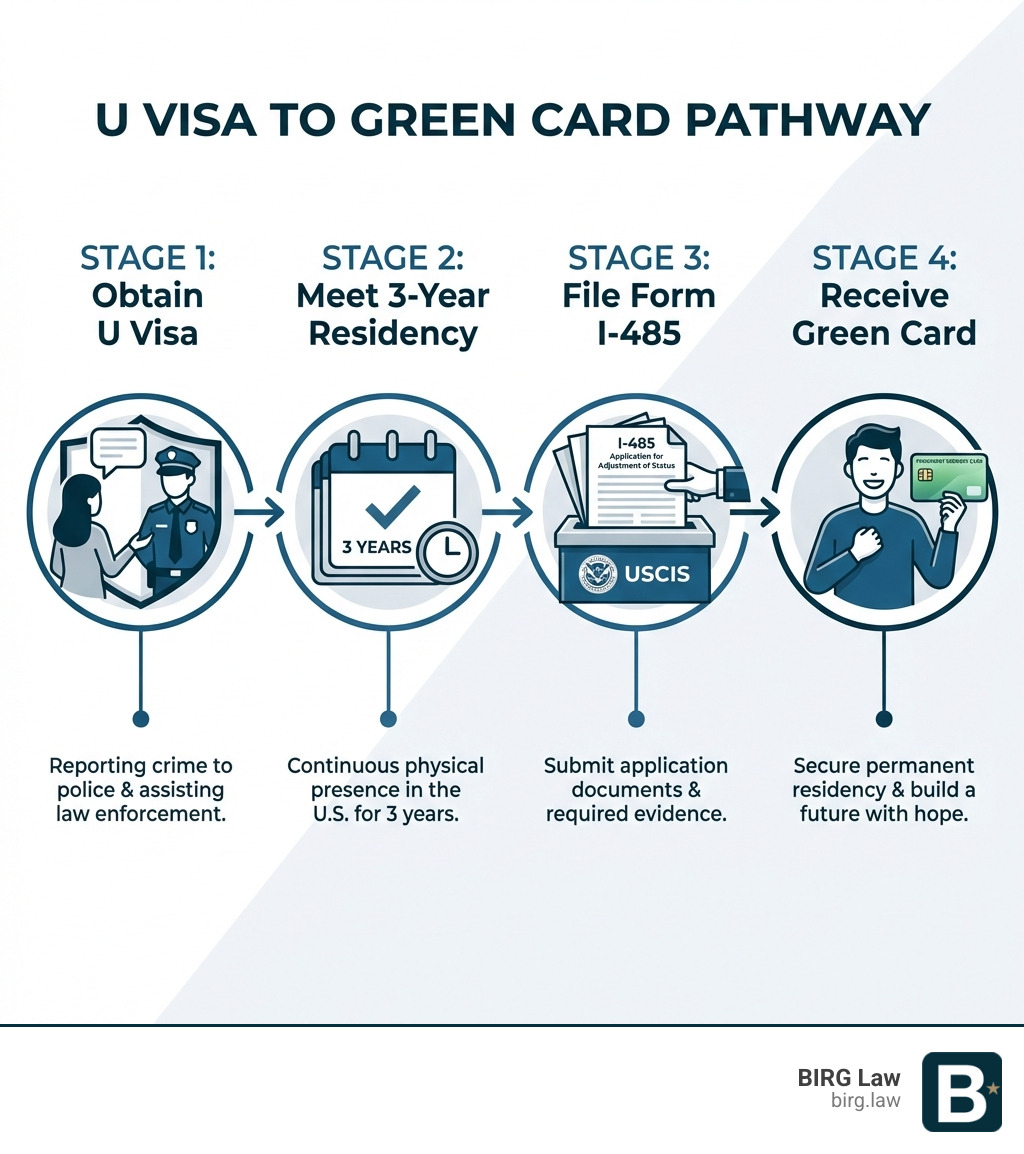
If you helped law enforcement after being a victim of crime and now hold a U visa, you may be able to apply for a green card after three years of continuous physical presence in the United States. This pathway allows you to move from temporary protection to lawful permanent residence, giving you stability, work authorization without renewal worries, and eventually, eligibility for U.S. citizenship.
Here is what you need to know about the U visa to Green Card process:
- Who qualifies: U visa holders who have been physically present in the U.S. for at least 3 continuous years
- What you need: Form I-485, proof of continuous presence, evidence of law enforcement cooperation, and medical examination
- Processing time: Typically 1.5 to 2.5 years after filing
- Family members: Spouses, children, and certain other relatives may also be eligible
- Key requirement: You must not have unreasonably refused to help law enforcement when requested
The U visa was created by Congress to protect crime victims and encourage them to report crimes without fear of deportation. It provides temporary legal status for up to four years, along with work authorization. But one of its most powerful features is the U visa to Green Card pathway, which offers a chance for victims to rebuild their lives permanently in the United States.
This transition represents more than just immigration status. It is about moving from vulnerability to stability, from temporary protection to permanent belonging. For many U visa holders, the Green Card represents the final step in reclaiming control over their lives after experiencing serious harm.
Core Eligibility: Are You Ready to Apply for a Green Card?
Before we dive into the nitty-gritty of the application process, let’s make sure you meet the fundamental requirements to transition from a U visa to a green card. Think of this as your eligibility checklist.

Meeting the Continuous Presence Rule for the U Visa to Green Card Transition
One of the most critical requirements for U visa holders seeking a Green Card is demonstrating continuous physical presence in the United States. You must have been physically present in the U.S. for at least three years since the date USCIS granted you U nonimmigrant status. This isn’t just about being in the country; it’s about maintaining a consistent presence.
What does “continuous period” mean in this context? USCIS is quite strict about this. Generally, you cannot have left the U.S. for a single trip that lasted more than 90 days, or for multiple trips that, when added together, total more than 180 days. If your absences exceed these limits, it can break your continuous physical presence, potentially jeopardizing your eligibility for a green card.
However, there’s a silver lining! If your absence from the U.S. was necessary to assist law enforcement in the investigation or prosecution of the criminal activity, USCIS might excuse it. This exception underscores the U visa’s purpose: to encourage victims to cooperate with authorities without fear of immigration consequences. It’s always best to consult with an immigration attorney if you anticipate or have had absences from the U.S. while holding U visa status, as detailed in U visa post-grant information.
Proving Continued Cooperation and Favorable Discretion
Your journey from a U visa to Green Card doesn’t end with your initial cooperation with law enforcement. After obtaining your U visa, you must continue to demonstrate that you have not “unreasonably refused” to provide further assistance to law enforcement or government officials if requested. This means remaining available and willing to help with the ongoing investigation or prosecution related to the qualifying criminal activity.
Beyond cooperation, USCIS exercises discretion when evaluating your green card application. This means they look at the “totality of the circumstances” of your case, weighing both positive and negative factors. The law states that your continued presence in the U.S. must be justified on humanitarian grounds, to ensure family unity, or in the public interest.
Here’s what USCIS considers:
- Humanitarian Grounds: This often relates to the trauma you experienced as a crime victim and the need for a safe environment to heal and rebuild your life.
- Family Unity: If you have family members in the U.S. (especially U.S. citizens or lawful permanent residents), your continued presence helps keep your family together.
- Public Interest: Your assistance in combating crime benefits the broader community, and granting you a green card reinforces the U visa program’s goal of encouraging cooperation.
In addition to these factors, USCIS will also consider your good moral character since obtaining your U visa. While the U visa itself offers broad waivers for past inadmissibility issues (which we’ll discuss later), maintaining a clean record and demonstrating positive contributions to society since receiving your U visa are crucial. This discretionary review is outlined in INA 245(m).
Your Step-by-Step Guide to Transitioning from a U Visa to a Green Card
Once you’ve confirmed your eligibility, it’s time to gather your documents and start on the application process. This part of your journey can feel like navigating a maze, but don’t worry – we’re here to help you every step of the way.

Step 1: Filing Form I-485 and Assembling Your Documents
The main form you’ll file to adjust your status from a U visa to Green Card is Form I-485, Application to Register Permanent Residence or Adjust Status. This form is the cornerstone of your application, telling USCIS that you’re ready to become a lawful permanent resident.
When it comes to filing fees, there’s some good news for U visa holders! While the Form I-485 filing fee for most applicants is currently $1,140 plus an $85 biometrics fee (as of 2024), U visa applicants are generally exempt from these fees. This exemption is a testament to the humanitarian nature of the U visa program. However, you may still need to cover the cost of a medical examination.
Where to send your application? As of now, U visa-based I-485 applications are typically filed at the Nebraska Service Center. However, filing addresses can change, so we always recommend checking the USCIS website for the most current instructions.
What documentation do you need? Preparing your “documentation arsenal” is key to a smooth process. Here’s a general list of what you’ll need to include:
- Form I-485: Your completed and signed application.
- Copy of your U visa approval (Form I-797): This is your official notification of U nonimmigrant status approval.
- Copy of your Form I-94, Arrival/Departure Record: This document proves your lawful entry and status in the U.S. You can often print this from the CBP website.
- Passport-style photos: Usually two recent photos.
- Government-issued identity document: A copy with your photograph.
- Birth certificate: A copy of your birth certificate.
- Medical examination (Form I-693): Completed by a USCIS-approved civil surgeon.
- Evidence of continuous presence: Documents proving your physical presence in the U.S. for the required three years (e.g., utility bills, employment records, school records, leases).
- Copies of any law enforcement certification forms (Form I-918 Supplement B): These were used during your initial U visa application.
- Police clearance certificates: From all areas you’ve lived in since obtaining U status.
Every case is unique, and additional documents may be required. Being thorough and organized from the start can prevent delays.
Step 2: Biometrics, Background Checks, and the Interview
After you’ve filed your Form I-485, USCIS will schedule you for a biometrics appointment at an Application Support Center (ASC). This appointment is usually quick and straightforward. They will collect your fingerprints, photograph, and signature. These biometrics are essential for conducting thorough background checks, which are a standard part of any green card application.
USCIS conducts comprehensive background checks, including criminal record checks and immigration history reviews, to ensure you are admissible to the United States. A clean criminal record since obtaining your U visa is a key factor in the approval of your application. If there are any concerns in your background, it’s crucial to address them proactively with your legal team.
Sometimes, USCIS might send a Request for Evidence (RFE) if something is missing from your application or if they need additional proof. Responding to an RFE promptly and completely is vital to avoid delays or even a denial.
Finally, while not all U visa adjustment of status applicants are interviewed, USCIS may schedule one. If an interview is required, it will typically focus on confirming the information in your application, your continuous presence, and your continued cooperation with law enforcement. Preparing for this interview with an attorney can help alleviate anxiety and ensure you’re ready to answer any questions confidently.
Bringing Your Family Along: Green Cards for Derivative U Visa Holders
Your journey to permanent residency doesn’t have to be a solo adventure. The U visa program wisely recognizes the importance of family unity, allowing certain family members to also obtain green cards.
Eligibility for Spouses, Children, and Other Relatives
The U visa program allows for “derivative” status, meaning that certain immediate family members of the principal U visa holder (the crime victim) can also receive U visas. These family members are categorized as:
- U-2: Spouse of the principal U-1 applicant.
- U-3: Children of the principal U-1 applicant.
- U-4: Parents of the principal U-1 applicant (if the principal was under 21 at the time of filing).
- U-5: Unmarried siblings under 18 of the principal U-1 applicant (if the principal was under 21 at the time of filing).
If your family members already hold derivative U visa status (U-2, U-3, U-4, or U-5), their path to a green card is quite similar to yours. They must also meet the requirement of three years of continuous physical presence in the U.S. since obtaining their derivative U visa status. They also need to demonstrate good moral character and that they have not unreasonably refused to assist law enforcement if requested. Each derivative family member will typically apply for their green card independently, meeting their own eligibility criteria. This mirrors the protections offered to victims under the Violence Against Women Act.
The Application Process for Family Members
For family members who already have derivative U visa status, each individual will file their own Form I-485, Application to Register Permanent Residence or Adjust Status. The process, documentation, biometrics, and potential interview will largely follow the same steps as the principal applicant.
What about family members who did not receive a derivative U visa but are still related to the principal U visa holder? This is where Form I-929, Petition for Qualifying Family Member of a U-1 Nonimmigrant, comes into play. The principal U visa holder can file Form I-929 for certain qualifying relatives (such as a spouse, child, parent, or sibling) who did not get a derivative U visa. The family relationship must have existed at the time the principal U visa was granted. This petition asks USCIS to decide that granting your family member a green card is warranted.
Often, principal applicants will file Form I-929 concurrently with their own Form I-485 application. This can help streamline the process so that by the time the principal’s green card is approved, USCIS can begin processing the family petitions. If a family member is outside the United States, they would undergo consular processing, which involves an interview at a U.S. Embassy or Consulate in their home country once their petition is approved and a visa is available.
Navigating Potential Problems: Delays, Inadmissibility, and Waivers
The path to a Green Card, while ultimately rewarding, can sometimes present bumps in the road. Understanding potential challenges and how to overcome them is crucial for a successful outcome.
Understanding and Overcoming Inadmissibility
One of the most significant problems in any immigration application, including the U visa to Green Card process, can be inadmissibility grounds. These are legal reasons why a person might be prevented from entering or remaining in the U.S. They are outlined in INA 212(a) and can include certain criminal convictions, immigration violations (like unlawful entry or visa overstays), health-related issues, or national security concerns.
The good news for U visa holders is that the U visa itself comes with a very broad waiver of inadmissibility. Many U visa holders have already received a waiver via Form I-192, Application for Advance Permission to Enter as Nonimmigrant, when their U visa was initially granted. This broad waiver authority is a key feature designed to ensure that crime victims are not penalized for past issues that might otherwise prevent them from cooperating with law enforcement.
However, understand that this waiver doesn’t cover everything. While most grounds of inadmissibility can be waived, some serious grounds, such as participation in Nazi persecution or genocide, cannot be waived. Furthermore, any new inadmissibility issues that arise after you receive your U visa (e.g., new criminal activity) can jeopardize your Green Card application. This is why maintaining good moral character and a clean record during your U visa status is so important.
Dealing with Processing Times and Maintaining Status
Patience, my friend, is a virtue, especially when dealing with USCIS processing times. While the transition from a U visa to a green card is generally faster than the initial U visa application, it can still take time. We often see processing times for Form I-485 applications by U visa holders ranging from 1 to 2 years, and sometimes longer. USCIS processing backlogs are a reality.
You can always check USCIS Processing Times online for current estimates, but remember these are just estimates.
What happens if your U visa is nearing expiration while your I-485 application is still pending? Don’t fret! USCIS will typically grant an extension of your U nonimmigrant status automatically upon filing for adjustment of status. This ensures you maintain legal status while your green card application is being processed.
You’ll also want to make sure your Employment Authorization Document (EAD) remains valid. If your U visa-based EAD is set to expire while your I-485 is pending, you can apply to renew it using Form I-765, Application for Employment Authorization. Maintaining your legal status and work authorization is paramount throughout this waiting period. For more information on securing your status, visit our page on Legal Status Help.
Frequently Asked Questions about the U Visa to Green Card Process
We understand you probably have a few questions bubbling up. Let’s tackle some of the most common ones we hear from U visa holders on their journey to a green card.
How long does it take to get a Green Card after a U visa?
The typical processing time for a Green Card application after holding a U visa can vary. Once you’ve filed Form I-485 and met all the eligibility requirements, USCIS may take anywhere from 1.5 to 2.5 years, sometimes longer, to make a decision. The processing time for the initial U visa petition itself can be quite lengthy, with some applicants waiting several years for a decision due to an annual cap of 10,000 visas for principal applicants. However, the adjustment of status process from U visa to green card is generally much quicker. It’s always best to check the official USCIS website for the most current processing time estimates for humanitarian categories.
Can I travel outside the U.S. while my Green Card application is pending?
Traveling outside the U.S. while your Form I-485 (Green Card application) is pending can be risky and is generally discouraged. If you leave the country without first obtaining an Advance Parole document (Form I-131, Application for Travel Document), USCIS may consider your I-485 application abandoned, leading to its denial. Advance Parole grants you permission to travel abroad and return to the U.S. while your green card application is pending. However, even with Advance Parole, certain travel can have adverse effects on your application. We strongly advise consulting with an experienced immigration attorney before making any travel plans to ensure you don’t inadvertently jeopardize your path to permanent residency.
What are the benefits of a Green Card over a U visa?
Obtaining a green card after holding a U visa provides significant, long-term benefits that improve your stability and quality of life in the United States:
- Lawful Permanent Resident Status: This is the most significant benefit, granting you permanent authorization to live and work anywhere in the U.S.
- Path to U.S. Citizenship: After holding a Green Card for five years (or three years if married to a U.S. citizen, though this is less common for U visa holders), you become eligible to apply for U.S. citizenship. Notably, the admission date on your Green Card obtained through U visa adjustment is backdated to three years before the approval date, potentially expediting your eligibility for citizenship!
- Ability to Travel More Freely: With a Green Card, you can travel internationally more freely and apply for a re-entry permit for extended trips abroad without fear of abandoning your status.
- Broader Employment Opportunities: A Green Card eliminates the need for employment authorization renewals and can open doors to a wider range of jobs and career advancements.
- Ability to Petition for Other Family Members: As a lawful permanent resident, you can petition for certain eligible family members to immigrate to the U.S., further strengthening your family unity.
Conclusion: Secure Your Future in the United States
The transition from a U visa to a green card is a life-changing step toward security and permanence in the U.S. While the process requires careful preparation and patience, it is an achievable goal that solidifies your future. The journey from victim to survivor to permanent resident is a testament to your resilience. If you are ready to take this final step, having an experienced legal team by your side is crucial. The attorneys at BIRG Law are dedicated to guiding U visa holders through every stage of the adjustment of status process, ensuring your application is strong and complete.
Ready to open up your path to a green card? Take the next step in your immigration journey with BIRG Law. We’re here to provide the expert legal support you need.
For more insights and support on U visas, explore our resources on U Visa Support.