



Why Choosing the Right Family Immigration Firm Changes Everything
A family immigration firm helps U.S. citizens and permanent residents bring loved ones to the United States legally and efficiently. Here’s a quick snapshot of what to expect:
- Who can sponsor: U.S. citizens and lawful permanent residents (LPRs)
- Who can be sponsored: Spouses, children, parents, and siblings (eligibility varies by sponsor status)
- Key forms: I-130 (petition), I-485 (adjustment of status), I-864 (Affidavit of Support)
- Processing time: Months to years, depending on visa category and country of origin
- First step: File Form I-130 to establish the qualifying family relationship
Family reunification is one of the most emotional and high-stakes legal journeys a person can go through. The U.S. immigration system, managed by U.S. Citizenship and Immigration Services (USCIS), is complex, slow-moving, and unforgiving of mistakes. A single missing document or outdated form can delay your case by months — or result in a denial.
That’s true whether you’re sponsoring a spouse from abroad, bringing a parent home, or navigating preference category backlogs that stretch on for years.
The rules also keep shifting. In 2025 alone, USCIS updated required form editions, tightened filing rules, and increased scrutiny around marriage-based applications. Staying current isn’t optional — it’s the difference between approval and rejection.
Getting the process right matters deeply. And it starts with having the right legal team by your side.
At Birg Law, we are a strategic family immigration firm based in Northfield and Chicago, with over 30 years of experience helping families navigate U.S. immigration law — from initial petitions to green card approvals and beyond.
Understanding Family-Based Immigration and Eligibility
At its core, family-based immigration is the process by which a person currently living in the U.S. with legal status “petitions” for a relative to join them. However, not everyone with a U.S. passport or a Green Card can sponsor just any relative. The law draws very specific lines around who qualifies as a sponsor and who can be a beneficiary.
As a family-based immigration attorneys, we often explain that the “power” of your sponsorship depends on your own status.
- U.S. Citizens: If you are a U.S. citizen, you have the broadest sponsorship rights. You can petition for your spouse, children (of any age, married or unmarried), parents (if you are at least 21), and siblings.
- Lawful Permanent Residents (LPRs): If you hold a Green Card, your options are more limited. You can sponsor your spouse and your unmarried children. Currently, LPRs cannot sponsor parents or siblings.
Age requirements also play a huge role. For example, to sponsor a parent or a sibling, the U.S. citizen sponsor must be at least 21 years old. Furthermore, the beneficiary’s status—whether they are already in the U.S. legally, overstayed a visa, or are living abroad—will dictate which legal path we take. To dive deeper into these nuances, you can read more about Immediate Relatives and Green Cards: What You Need to Know.
Immediate Relatives vs. Preference Categories
The U.S. government divides family members into two main buckets. Understanding which bucket your relative falls into is the most important factor in predicting how long you will be separated.
- Immediate Relatives: This category includes the spouses, unmarried children (under 21), and parents of U.S. citizens. There is no annual limit on the number of visas available for this group. This means as soon as the paperwork is processed, a visa is waiting. This is the “fast track.”
- Family Preference Categories: This group includes the adult children and siblings of U.S. citizens, as well as the spouses and children of LPRs. Because the government sets annual quotas on these visas, there is often a long line.
When you hear people talk about “priority dates,” they are talking about their place in this line. Depending on the category and the country of origin, the wait can range from a few years to over a decade. We recommend checking out our guide on Fast-Track or Long Wait: Decoding Family-Based Immigration Categories to see where your family member stands.
The Step-by-Step Process with a Family Immigration Firm
Navigating the bureaucracy of U.S. Citizenship and Immigration Services (USCIS) is like walking through a minefield. One wrong step, and the whole process can blow up. When you work with an immigration lawyer in Chicago area, we break the process down into manageable phases.

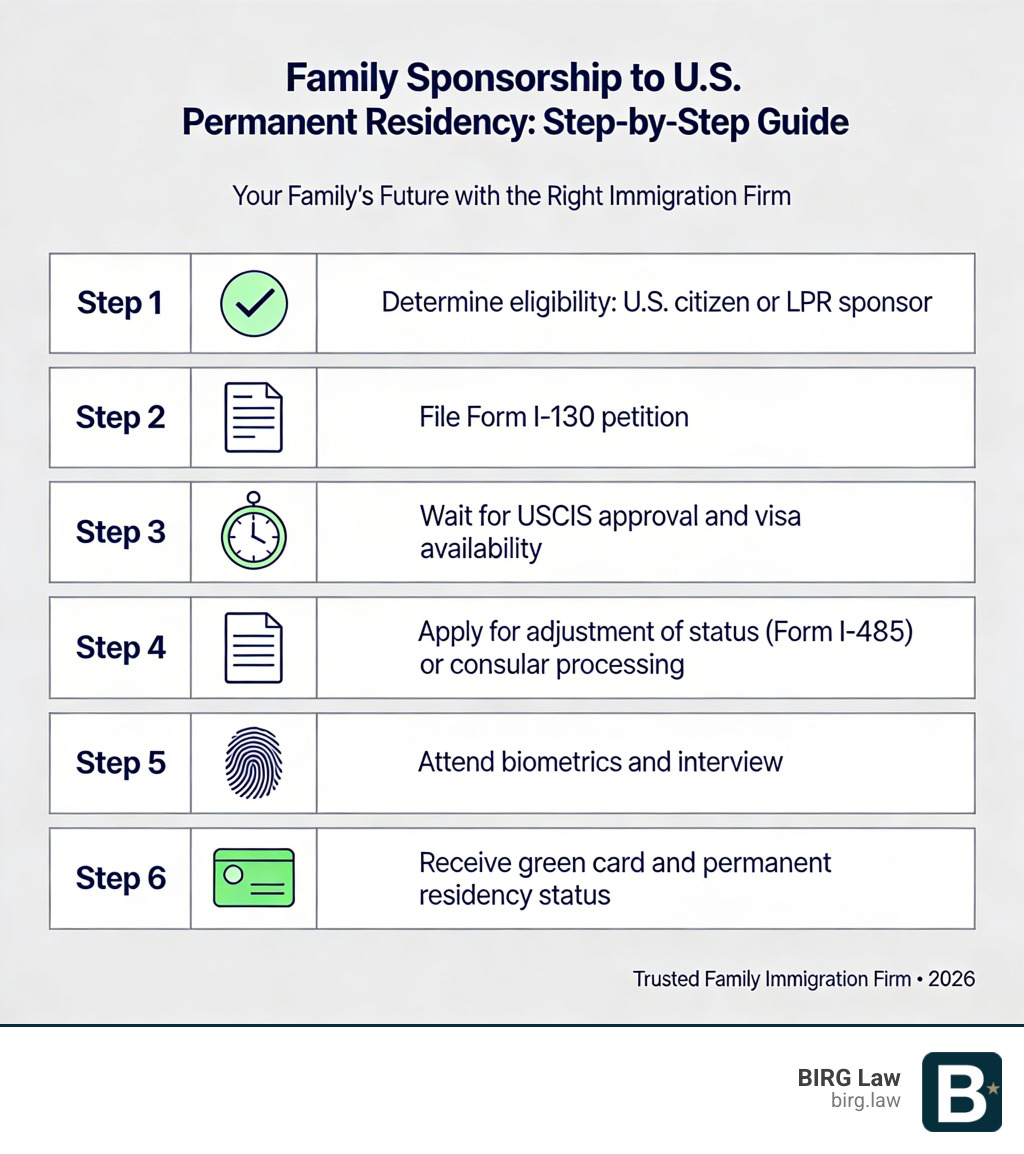
The journey almost always begins with Form I-130, Petition for Alien Relative. This form doesn’t give your relative a Green Card; it simply proves to the government that a valid relationship exists (e.g., you really are married, or this really is your sister).
Once the I-130 is approved, the path splits:
- Adjustment of Status (Form I-485): If your relative is already in the U.S. legally, they may be able to apply to “adjust” their status to permanent resident without leaving the country. This is common for spouses of U.S. citizens who entered on a valid visa.
- Consular Processing: If your relative is outside the U.S., the case moves to the National Visa Center (NVC) and eventually to a U.S. Embassy or Consulate in their home country for an interview.
Each path requires meticulous Family-Based Visas & Green Card preparation. We handle the heavy lifting, ensuring every box is checked and every supporting document is translated and formatted correctly.
Proving a Bona Fide Relationship and Financial Support
The government is naturally suspicious. They want to ensure that marriages are “bona fide”—meaning they were entered into for love and a life together, not just for a Green Card. To combat marriage fraud, a family immigration firm will help you compile a mountain of evidence. We’re talking joint bank statements, leases with both names, photos of your wedding and family vacations, and even affidavits from friends who can swear to your relationship.
Beyond the relationship, the sponsor must prove they can financially support the immigrant. This is done through Form I-864, Affidavit of Support. The sponsor must demonstrate an income that is at least 125% of the Federal Poverty Guidelines. If the sponsor’s income isn’t high enough, we may need to find a “joint sponsor.”
| Requirement | U.S. Citizen Sponsor | Permanent Resident (LPR) Sponsor |
|---|---|---|
| Sponsor Siblings? | Yes | No |
| Sponsor Parents? | Yes (if 21+) | No |
| Financial Threshold | 125% of Poverty Line | 125% of Poverty Line |
| Visa Availability | Immediate (for spouses/parents) | Subject to Quotas |
| Divorce Impact | I-864 obligation continues | I-864 obligation continues |
It is a common misconception that a prenuptial agreement or a divorce ends the sponsor’s financial obligation. Under the law, the I-864 is a contract with the U.S. government that usually lasts until the immigrant becomes a citizen or works for 10 years.
Navigating 2025 USCIS Changes and Processing Timelines
If you are starting your application now, you are dealing with a different USCIS than the one that existed just a year ago. As of early 2025, several rigid filing rules have been implemented that can catch families off guard.
Processing delays are also a reality. While some marriage-based Green Cards are being processed quickly, others are facing backlogs due to increased security checks and staffing shortages. The Department of State Visa Bulletin remains the “bible” for tracking wait times in preference categories.
New 2025 Rules for a Family Immigration Firm to Handle
The “quiet evolution” of USCIS in 2025 has brought several technical hurdles:
- New Form Editions: USCIS has released new versions of the I-485 and I-129F. Using an old edition (even by a few days) will result in an immediate rejection of the entire package.
- Separate Payments: You can no longer send one big check for multiple forms. Each form must have its own separate payment (check or money order) to avoid processing errors.
- Medical Exams (I-693): It is now highly recommended to include the medical exam at the time of initial filing to prevent “Requests for Evidence” (RFEs) that can delay a case by months.
- Fraud Prevention: There is a renewed focus on fraud. The I-130 webpage now actively encourages the public to report suspicious marriages, meaning your evidence must be stronger than ever.
- Vaccine Updates: As of January 2025, the COVID-19 vaccination is no longer a mandatory requirement for the immigration medical exam, providing some relief for applicants with concerns in that area.
Choosing the Best Family Immigration Firm for Your Case
When you search for a family immigration attorney in Chicago, you aren’t just looking for someone to fill out forms — you’re looking for an advocate.
At Birg Law, we pride ourselves on being a premier immigration lawyers in Chicago area. We don’t just process papers; we build strategies. Whether you are dealing with a complex case involving a prior visa overstay, a “Request for Evidence,” or a potential inadmissibility issue, you need a firm that has seen it all.
What to Look for in a Family Immigration Firm
When vetting an immigration attorney near me in Chicago, ask the following questions:
- What is your success rate with cases like mine? Look for firms with a history of high success rates and 5-star reviews.
- Do you offer multilingual support? Immigration is a global matter. Having a staff that speaks Spanish, Polish, or other languages ensures nothing is lost in translation.
- How do you handle communication? You deserve transparent updates. There is nothing more stressful than “radio silence” from your lawyer while your family’s future hangs in the balance.
- Are you a specialist? General practice lawyers might dabble in immigration, but a dedicated family immigration firm lives and breathes these regulations every day.
Why Experience Matters for a Family Immigration Firm
Experience isn’t just a number; it’s the ability to anticipate problems before they happen. Our firm brings decades of success in family sponsorships. We’ve been helping immigrants since 1975—nearly 50 years of navigating the ever-changing tides of U.S. policy.
From our office in Northfield, IL, we provide the kind of sophisticated legal counsel usually reserved for big-city firms, but with the compassion and personalized touch of a local partner. We’ve handled everything from straightforward spouse petitions to complex deportation defense and litigation. When the stakes are this high, you don’t want a “form filler”—you want a strategist.
Frequently Asked Questions about Family Sponsorship
How long does a marriage green card take in 2025?
While it varies, most marriage-based Green Cards for spouses of U.S. citizens currently take between 10 to 18 months. However, providing a “decision-ready” file (including medical exams and robust evidence) can sometimes speed this up.
Can a permanent resident sponsor a sibling?
No. Under current U.S. law, only U.S. citizens who are at least 21 years old can sponsor their siblings. If you are a permanent resident, you must first become a naturalized citizen before you can petition for your brothers or sisters.
What happens if my sponsorship interview goes wrong?
If an interview doesn’t go well—perhaps due to nerves or conflicting answers—USCIS may issue a “Notice of Intent to Deny” (NOID) or schedule a second, more intensive “Stokes Interview.” This is a critical moment where having an experienced family immigration attorney is vital to provide additional evidence and legal arguments to save the case.
Conclusion
Your family deserves to be together, and the U.S. immigration system shouldn’t be the wall that keeps you apart. While the process is undoubtedly daunting, it is also a path that thousands of families successfully navigate every year.
At Birg Law, we are committed to providing compassionate, strategic, and professional service to the Northfield and Chicago communities. We understand that behind every I-130 form is a human story — a husband waiting for his wife, a child waiting for their parent, or a family finally finding safety and a future in the United States.
If you’re ready to take the first step toward your family’s future, we are here to guide you. From the first consultation to the final Green Card delivery, we stand by your side. Explore our services regarding Family-Based Visas & Green Card and let’s start building your American dream together.