



Understanding Green Card Eligibility for Family Members
Green card relatives are family members eligible for lawful permanent residence in the U.S. through sponsorship by a U.S. citizen or green card holder. Here’s a brief overview:
Who Can Sponsor:
- U.S. Citizens: Spouses, children (unmarried under 21, unmarried adult, or married), parents (if the citizen is 21+), and siblings.
- Green Card Holders: Spouses and unmarried children only.
Two Main Categories:
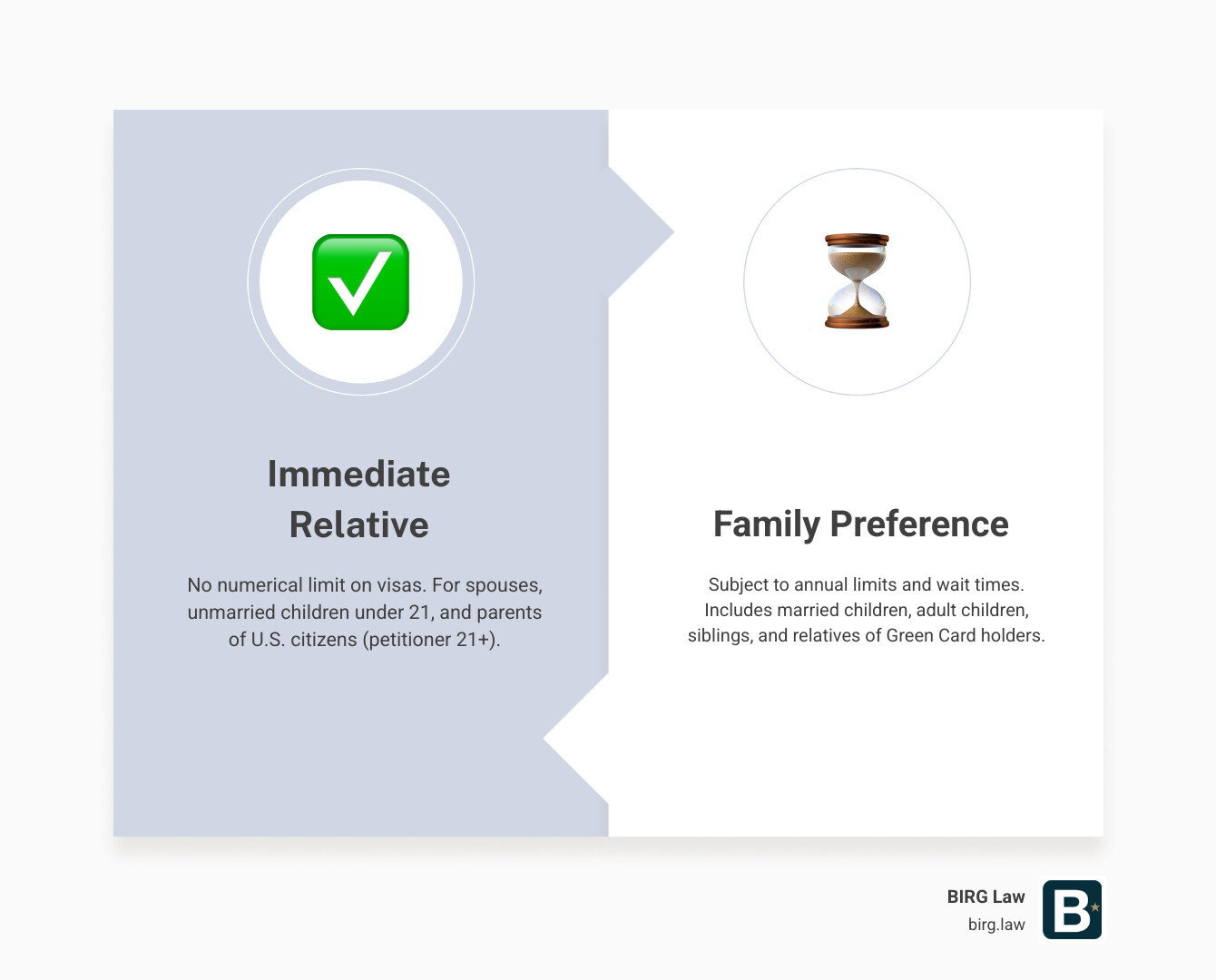
- Immediate Relatives: Spouses, unmarried children under 21, and parents of U.S. citizens. Visas are unlimited, so there’s no waiting period.
- Family Preference: All other eligible relatives. Annual visa limits mean there are often significant wait times.
The Basic Process:
- File Form I-130, Petition for Alien Relative.
- Wait for visa availability (for Family Preference categories).
- Apply for a green card via Adjustment of Status (in the U.S.) or Consular Processing (abroad).
- Attend a medical exam and interview.
- Receive green card approval.
Family reunification is a cornerstone of U.S. immigration. However, the process involves complex steps, forms, and potential wait times depending on the family relationship. At Birg Law, we have over 30 years of experience guiding families through these cases. Our team provides strategic representation to help clients steer visa backlogs, inadmissibility issues, and overwhelming documentation.
Understanding Family-Based Green Card Categories
Understanding the main categories of family-based immigrant visas is the first step in bringing relatives to the United States. U.S. immigration law prioritizes family reunification through a structured system with two primary categories: Immediate Relative and Family Preference. The category your relative falls into dictates visa availability and processing times. For more details, you can review our guide on Family-Based Visas & Green Card or the U.S. Department of State’s chart of immigrant visa categories.
Immediate Relative vs. Family Preference Visas
The key difference between Immediate Relative (IR) and Family Preference (F) visas is their annual numerical limits.
- Immediate Relative (IR) Visas: Reserved for the closest family members of U.S. citizens, these visas have no annual cap. This means a visa is always available once the petition is approved, making it one of the fastest paths for green card relatives.
- Family Preference (F) Visas: For more distant relatives of U.S. citizens and certain family members of Lawful Permanent Residents (LPRs), these visas are subject to annual limits. This creates a waiting list, often several years long, for a visa to become available.
Who Qualifies as an Immediate Relative?
To qualify as an Immediate Relative, the family member must have one of the following close relationships with a U.S. citizen petitioner. As there are no annual quotas, an immigrant visa is always available for these green card relatives once the initial petition is approved. More information is available at Green Card for Immediate Relatives of U.S. Citizen.
- Spouse of a U.S. citizen.
- Unmarried child under 21 of a U.S. citizen.
- Parent of a U.S. citizen, if the petitioner is at least 21 years old.
The Family Preference Categories
Family members who do not qualify as Immediate Relatives fall into the Family Preference categories. These are subject to annual numerical limits, resulting in a waiting period that depends on the preference category and the beneficiary’s country of origin.

- First Preference (F1): Unmarried sons and daughters (21 or older) of U.S. citizens.
- Second Preference (F2):
- F2A: Spouses and unmarried children (under 21) of Lawful Permanent Residents.
- F2B: Unmarried sons and daughters (21 or older) of Lawful Permanent Residents.
- Third Preference (F3): Married sons and daughters of U.S. citizens.
- Fourth Preference (F4): Brothers and sisters of U.S. citizens (petitioner must be 21 or older).
For more details on these categories, see the USCIS page on Family of Green Card Holders (Permanent Residents).
The Sponsorship Process: How to Petition for Green Card Relatives
The journey to obtaining a green card for a relative begins with a formal sponsorship process. This involves filing a petition with U.S. Citizenship and Immigration Services (USCIS) and, if your relative is abroad, working with the National Visa Center (NVC).
The First Step: Filing Form I-130
The first step is filing Form I-130, Petition for Alien Relative. This form’s purpose is to establish a qualifying family relationship between you (the petitioner) and your eligible relative (the beneficiary). A U.S. citizen or lawful permanent resident must file this petition.

Filing Form I-130 does not grant any immigration status; it simply asks USCIS to recognize the family relationship. A separate Form I-130 is needed for each relative you sponsor. You can submit a United States Citizenship and Immigration Services (USCIS) Form I-130 online or by mail.
What Happens After the I-130 is Filed?
After submitting Form I-130, you will receive a receipt notice from USCIS with a “priority date.” This date is when USCIS received your petition. For Immediate Relatives, it’s a tracking number. For Family Preference categories, the priority date is critical as it determines your relative’s place in the visa queue.
Once USCIS approves the I-130, the next steps depend on your relative’s location and visa availability:
- If your relative is in the U.S. and a visa is available: They may be able to file Form I-485 to apply for a green card, a process known as “Adjustment of Status.”
- If your relative is outside the U.S. or must wait for a visa: The approved petition is sent to the National Visa Center (NVC), which will guide them through “Consular Processing” at a U.S. embassy or consulate abroad.
Changing between consular processing and adjustment of status is possible but requires coordinating with USCIS and the NVC. In some cases, this may require filing Form I-824, Application for Action on an Approved Application or Petition.
The Two Paths to a Green Card: Adjustment of Status vs. Consular Processing
Once the Form I-130 petition is approved, your relative will follow one of two paths to get their green card: Adjustment of Status or Consular Processing. The correct path depends on whether they are in the United States or abroad.
| Feature | Adjustment of Status (AOS) | Consular Processing (CP) |
|---|---|---|
| Applicant Location | Physically present in the U.S. (must have entered legally or qualify for an exception) | Residing outside the U.S. |
| Primary Form | Form I-485, Application to Register Permanent Residence or Adjust Status | DS-260, Immigrant Visa Application (submitted to NVC) |
| Interview Location | USCIS office in the U.S. | U.S. Embassy or Consulate in the applicant’s home country |
| Travel During Process | Requires Advance Parole (Form I-131) to travel internationally without abandoning AOS | Applicant remains abroad until visa approval |
| Key Advantage | Can remain in the U.S. while application is pending; potentially faster for IR categories | Generally required if not in the U.S.; can be faster for some preference categories |
| Key Disadvantage | Strict eligibility requirements (e.g., lawful entry, no “bars to adjustment”) | Requires travel to home country for interview; potential travel ban issues for some |
Applying from Within the U.S: Adjustment of Status
Adjustment of Status allows an eligible relative already in the U.S. to apply for a green card without leaving the country. This lets them remain with family and often get work authorization while the application is pending. For more, see our The Essential Guide to Adjustment of Status in the United States.
Key eligibility requirements for Adjustment of Status include:
- Lawful Entry: The applicant must have been inspected and admitted or paroled into the U.S.
- Visa Availability: A visa must be immediately available. This is always true for Immediate Relatives, but Family Preference applicants must check the Visa Bulletin.
- Admissibility: The applicant must be admissible to the U.S. or eligible for a waiver.
If these conditions are met, the relative files Form I-485. Learn more at the USCIS page on Adjustment of Status.
Applying from Abroad: Consular Processing
Consular Processing is for green card relatives living outside the U.S. After USCIS approves the I-130, the case moves to the Department of State’s National Visa Center (NVC), which collects documents and fees.
Once documents are submitted and a visa is available, the NVC schedules an interview at a U.S. embassy or consulate in the applicant’s home country. The general steps include:
- NVC Processing: Submitting civil documents and the Affidavit of Support (Form I-864).
- Medical Examination: Completing a medical exam with an authorized physician.
- Interview: Attending an interview with a consular officer.
- Visa Issuance: If approved, the applicant receives an immigrant visa to travel to the U.S. and become a permanent resident upon entry.
For more on this process, see the USCIS guide to Consular Processing and the State Department’s steps for an immigrant visa.
Navigating Eligibility: Requirements, Bars, and Inadmissibility
Understanding the eligibility criteria for green card relatives goes beyond simply having a qualifying family relationship. It involves navigating complex requirements, potential “bars to adjustment,” and “grounds of inadmissibility.” This is where our expertise at Birg Law becomes invaluable, as we carefully review each client’s unique situation.
For a detailed exploration of how these factors can impact your case, we recommend reviewing Fast Track or Long Wait? Decoding Family-Based Immigration Categories.
Eligibility Requirements for Immediate green card relatives in the U.S.
For immediate green card relatives in the U.S. seeking Adjustment of Status, key requirements include:
- Lawful Entry: Proof of inspection and admission or parole into the U.S. (e.g., Form I-94 from the CBP website).
- Valid Relationship: The qualifying family relationship must still exist.
- Admissibility: The applicant must be admissible to the U.S. or eligible for a waiver.
Typical Documentation: Applicants must submit Form I-485 along with supporting evidence, such as identity documents, birth and marriage certificates, proof of the petitioner’s status, the approved Form I-130 notice, a medical examination (Form I-693), and an Affidavit of Support (Form I-864). Immediate relatives cannot include their own spouses or children as derivative beneficiaries; each must have their own separate petition.
Work and Travel: While the I-485 is pending, applicants can file Form I-765 for work authorization and Form I-131 for Advance Parole to travel abroad without abandoning their application.
Eligibility for Family Preference green card relatives in the U.S.
Family preference green card relatives in the U.S. have similar requirements, with one critical addition: a visa must be immediately available. They must also generally prove they have maintained lawful status since entering the U.S., though some exceptions like INA 245(i) may apply.
- Derivative Applicants (Spouse and Children): Unlike immediate relatives, principal applicants in a Family Preference category can include their spouse and unmarried children under 21 as derivative applicants on their green card application.
Typical Documentation: The required documents are similar to those for immediate relatives, with an added emphasis on proving visa availability and maintenance of lawful status.
Understanding Priority Dates and the Visa Bulletin
For Family Preference categories, the “priority date” (the date the I-130 was filed) determines one’s place in the visa waiting line. The U.S. Department of State’s monthly Visa Bulletin shows which priority dates are “current,” meaning a visa is available. Wait times can be significant, so monitoring the bulletin is essential.
Common Bars to Adjustment and Grounds of Inadmissibility
Certain issues can prevent an otherwise eligible relative from getting a green card.
- Bars to Adjustment: These factors, found in section 245(c) of the Immigration and Nationality Act (INA), can block Adjustment of Status. Common bars include unauthorized work or overstaying a visa. Importantly, Immediate Relatives of U.S. citizens are exempt from many of these bars.
- Grounds of Inadmissibility: These are reasons listed in INA 212(a) for denying entry or a green card, such as certain health issues, criminal convictions, or immigration fraud. If a ground of inadmissibility applies, a waiver may be available. We help clients identify these issues and pursue waivers to overcome them.
Special Green Card Categories for Relatives
Beyond the standard family categories, several unique pathways to a green card exist, often for specific or humanitarian situations. For a complete list, see the Green Card Eligibility Categories on the USCIS website.
Fiancé(e)s, Widow(er)s, and Military Families
- Fiancé(e) K-1 Visa: A U.S. citizen can petition for a fiancé(e) abroad to enter the U.S. on a K-1 visa. After marrying within 90 days, the fiancé(e) can apply for a green card.
- Widow(er) of a U.S. Citizen: A widow(er) may self-petition for a green card if they were married to a U.S. citizen at the time of death. The petition must generally be filed within two years of the spouse’s death.
- Military Families: Special provisions like “Parole in Place” (PIP) allow undocumented family members of U.S. military personnel to apply for a green card from within the U.S., even if they entered without inspection.
Humanitarian Pathways (VAWA, Asylees, Victims of Crime)
- VAWA Self-Petitioners: Under the Violence Against Women Act (VAWA), victims of abuse by a U.S. citizen or LPR spouse, parent, or adult child can secretly self-petition for a green card without the abuser’s involvement.
- Refugees and Asylees: Individuals granted refugee or asylee status can apply for a green card one year after their status is granted.
- Victims of Trafficking and Crime (T and U Visas): Victims of human trafficking (T visa) or certain other crimes (U visa) who assist law enforcement may be eligible to apply for a green card after three years of continuous presence in the U.S.
Other Unique Green Card Options
- Diversity Visa (DV) Lottery: This program provides up to 50,000 visas annually to individuals from countries with low rates of immigration to the U.S.
- Registry: A long-term resident who has lived in the U.S. continuously since before January 1, 1972, may be eligible to register for a green card.
- Special Immigrant Green Cards: This includes various groups like religious workers and certain Afghan or Iraqi nationals who assisted the U.S. government.
- Employment-Based Green Cards: While not family-based, these are common pathways for individuals with specific job skills or for investors who create U.S. jobs.
- Cuban Adjustment Act: This act provides a path to permanent residency for certain Cuban natives or citizens after being physically present in the U.S. for at least one year.
Frequently Asked Questions about Green Cards for Relatives
Navigating immigration law brings up many questions. Here are answers to some common inquiries we receive about green card relatives.
When can Form I-130 and Form I-485 be filed at the same time?
Filing Form I-130 (the petition) and Form I-485 (the green card application) at the same time is called “concurrent filing.” This is generally possible when:
- The beneficiary is an Immediate Relative of a U.S. citizen (spouse, unmarried child under 21, or parent) and is in the U.S. and otherwise eligible to adjust status.
- A visa is immediately available for a Family Preference beneficiary who is in the U.S. and eligible to adjust. Applicants must check the Visa Bulletin to confirm visa availability.
Concurrent filing can streamline the process by allowing USCIS to review the relationship and the green card application together.
Can a spouse or child of my relative also get a green card?
This depends on the primary applicant’s immigration category:
- Immediate Relatives: No. Spouses and children of immediate relatives cannot be included as “derivative beneficiaries.” Each immediate relative must have their own separate Form I-130 petition filed by the U.S. citizen sponsor.
- Family Preference Categories: Yes. The spouse and unmarried children (under 21) of the principal applicant can be included as derivative beneficiaries on the same green card application, allowing the family to immigrate together.
How can I check processing times and visa availability?
Staying informed is crucial. Use these official government resources for updates:
- USCIS Processing Times: Visit the USCIS Processing Time Information page to see estimated timelines for specific forms and service centers.
- Visa Availability: For Family Preference categories, the monthly Visa Bulletin from the Department of State shows which priority dates are current.
- Case Status: Use the Check My Case Status tool on the USCIS website with your 13-character receipt number to track your specific application.
Conclusion
Bringing green card relatives to the United States is a journey with specific requirements, detailed forms, and potential waiting periods. Understanding the differences between Immediate Relative and Family Preference categories and preparing for either Adjustment of Status or Consular Processing is critical.
The complexity of U.S. immigration law, with its changing processing times and visa backlogs, highlights the need for expert guidance. At Birg Law, our dedicated and strategic approach helps ensure successful outcomes. We simplify the process, address issues like bars to adjustment or inadmissibility, and advocate for your family’s reunification.
If you are considering sponsoring a relative or have questions about your family’s immigration path, we invite you to Contact Birg Law to discuss your family-based immigration needs. Our team is ready to provide the expert legal services you deserve.