



Understanding Your Permanent Resident Card
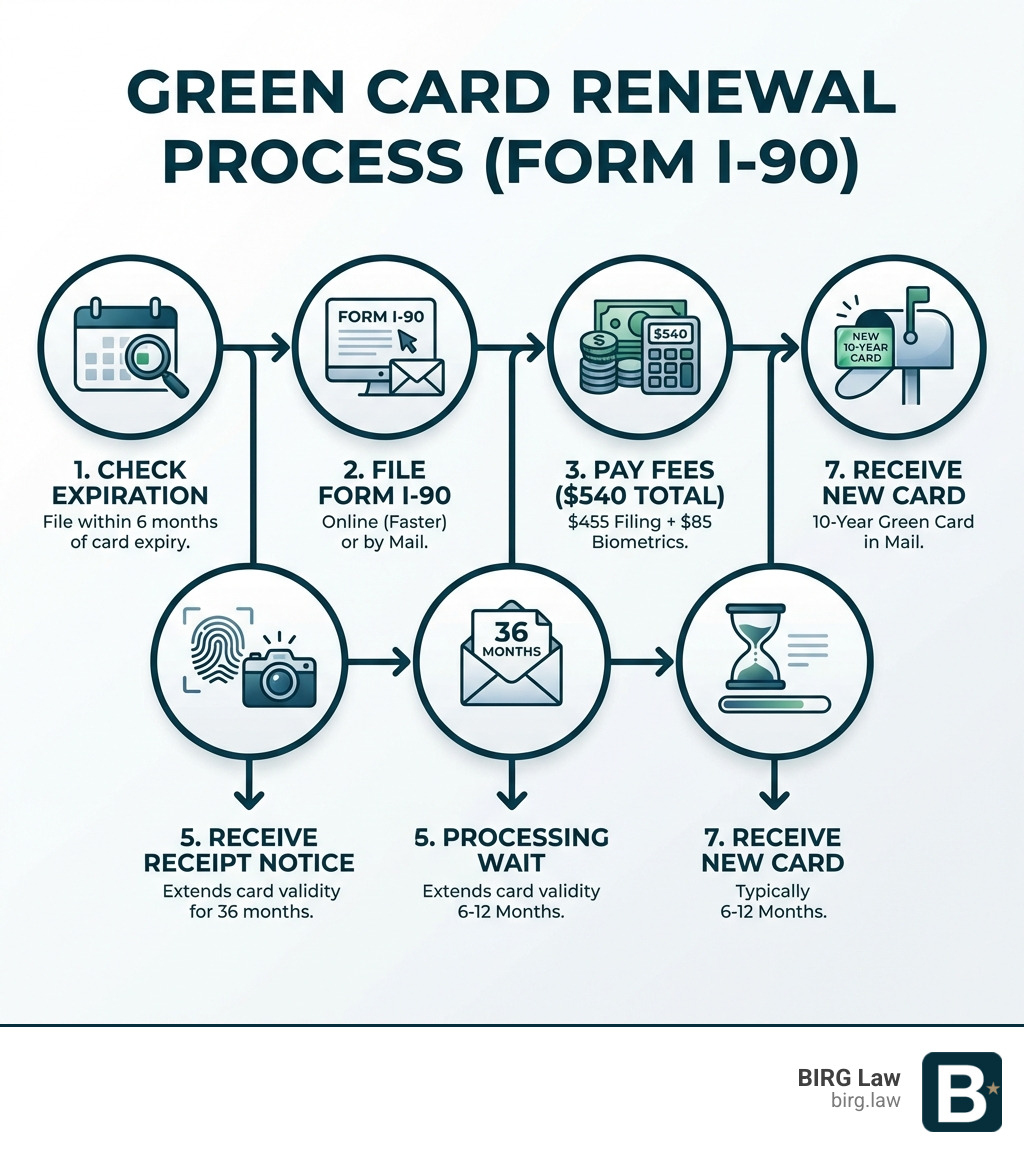
How to renew green card: File Form I-90 (Application to Replace Permanent Resident Card) with USCIS either online or by mail within 6 months of your card’s expiration date. The process requires submitting supporting documents, paying the filing fee ($455) and biometrics fee ($85), and attending a biometrics appointment. Processing typically takes 6-12 months.
Quick Steps to Renew Your Green Card:
- Check your card’s expiration date – File within 6 months before it expires
- Gather required documents – Current Green Card, government-issued photo ID
- Complete Form I-90 – Online (faster) or by mail
- Pay the fees – $540 total ($455 filing + $85 biometrics)
- Attend biometrics appointment – For fingerprints and photos
- Receive your new card – After USCIS approval
Your Green Card (officially called a Permanent Resident Card) proves your lawful permanent resident status in the United States. While your status as a permanent resident doesn’t expire, the physical card itself does—typically every 10 years.
An expired card creates real problems. You may face difficulties proving your work authorization to employers, encounter complications when traveling internationally, or struggle to access benefits you’re entitled to. That’s why keeping your card current is essential.
The good news? The renewal process is straightforward if you know the steps. USCIS has even made it easier by extending the validity of expired cards to 36 months for those who file Form I-90 on time.
At Birg Law, we’ve guided countless permanent residents through the green card renewal process over our 30+ years of immigration practice, ensuring they maintain their legal status without unnecessary stress. Understanding how to renew green card documentation properly is crucial to avoiding delays or denials that could impact your life in the United States.
Who Needs to Renew or Replace Their Green Card?
The need to update your Green Card typically falls into two categories: renewal and replacement. While the terms are often used interchangeably, there’s a subtle but important distinction, especially depending on your specific immigration status.
Green Card renewal generally applies to lawful permanent residents holding a 10-year Green Card that is expiring soon. Replacement can apply to any permanent resident (lawful or conditional) whose card is lost, stolen, damaged, contains incorrect information, or needs to be updated for other specific reasons.
Lawful Permanent Residents (10-Year Green Card)
If you are a lawful permanent resident with a standard 10-year Green Card, you will need to renew it when it expires. Your permanent resident status itself does not expire, but the physical card serves as proof of that status and has a validity period. USCIS recommends filing your renewal application within six months before your card’s expiration date. This ensures you have ample time for processing and avoid any gaps in your proof of status.
Reasons you might need to replace your 10-year Green Card (beyond it expiring) include:
- Your card was lost, stolen, mutilated, or destroyed.
- Your card contains incorrect information due to a USCIS error.
- You have legally changed your name or other biographic information.
- You received your Green Card before your 14th birthday, and you are now 14 or older (unless your card expires before your 16th birthday).
- You have an older version of the alien registration card (e.g., AR-3, AR-103, I-151) that is no longer valid.
- You were a commuter resident and are now taking up actual residence in the U.S., or vice versa.
- You never received your previously issued card.
For most of these scenarios, including renewing an expiring 10-year card or replacing a lost one, you will use Form I-90, Application to Replace Permanent Resident Card.
Conditional Permanent Residents (2-Year Green Card)
Conditional permanent residents are in a slightly different boat. If you received your Green Card through marriage to a U.S. citizen and your marriage was less than two years old at the time your Green Card was approved, you likely received a two-year conditional Green Card. Similarly, investors who obtain Green Cards also receive conditional status.
Conditional permanent residents cannot simply “renew” their two-year Green Card. Instead, you must file a petition to remove the conditions on your residence. This is a crucial step to convert your conditional status into permanent, unconditional resident status.
You must file this petition during the 90-day window immediately preceding the expiration date on your conditional Green Card. Failing to do so can lead to the termination of your status and even removal proceedings.
- If your conditional residency is marriage-based, you will file Form I-751, Petition to Remove Conditions on Residence. This form is typically filed jointly with your spouse, demonstrating that your marriage was entered into in good faith and is ongoing.
- If your conditional residency is investor-based, you will file Form I-829, Petition by Entrepreneur to Remove Conditions on Residence.
For more detailed information on family-based immigration and conditional Green Cards, we invite you to explore our resources on Family-Based Visas & Green Card.
Step-by-Step Guide: How to Renew Your Green Card
For most lawful permanent residents, the process of how to renew green card involves filing Form I-90. Let’s walk through the steps, documents, and fees involved.
Required Documents and Fees
When preparing to renew or replace your Green Card, gathering the correct documents and understanding the associated fees is paramount. A common reason for delays or rejections is incomplete applications or incorrect payments.
Here’s a list of generally required documents:
- Copy of your current Green Card (front and back), even if expired.
- Government-issued photo identification (if you’re replacing your card due to a name change or to correct other information).
- Recent passport-style photos (though often not required for I-90, it’s good practice to have them ready, especially if USCIS requests them).
- Documents supporting any legal name changes (e.g., marriage certificate, court order).
- Police report or incident report if your card was lost or stolen.
Regarding fees, as of 2025, the cost to file Form I-90 is a total of $540, which includes:
- Application Filing Fee: $455
- Biometric Services Fee: $85
These fees are subject to change, so we always recommend checking the most up-to-date information. You can use the official USCIS fee calculator to find out the cost for your specific form.
While not mandatory, many individuals choose to incur optional legal fees by hiring an immigration attorney. This can range from $1,500 to $2,500 or more, depending on the complexity of your case. While our firm, Birg Law, is based in Northfield, IL, and serves clients in Northbrook, Glencoe, Chicago, and Winnetka, we understand that legal counsel can be an invaluable investment for navigating the nuances of immigration law and ensuring a smooth process.
How to Renew Your Green Card Online
Filing your Form I-90 online is often the most convenient and efficient method. It offers several advantages, including faster processing, real-time case status updates, and the ability to upload documents digitally.
- Create a USCIS Online Account: If you don’t already have one, your first step is to create a USCIS online account. This will be your hub for managing your application.
- Complete Form I-90 Digitally: Once logged in, you’ll find the option to file Form I-90. The online system guides you through each section, prompting for necessary information such as your personal details, Green Card specifics, and the reason for renewal.
- Upload Evidence: You’ll be able to scan and upload copies of your supporting documents directly to your online application.
- Pay Fees: After completing the form, you’ll be directed to Pay.gov to pay the filing and biometrics fees electronically using a credit card.
- Submit Application: Review all your information carefully before digitally signing and submitting your application. You’ll receive an immediate confirmation of submission.
How to Renew Your Green Card by Mail
If you prefer a traditional approach, you can also renew your Green Card by mail.
- Download Form I-90: Start by downloading the most current version of Form I-90 from the USCIS website. Ensure you’re using the correct edition date to avoid rejection.
- Complete the Paper Form: Fill out the form clearly and accurately. We recommend typing your responses or writing in black ink.
- Assemble Supporting Documents: Make copies of all required documents. Do not send original documents unless specifically requested by USCIS. Keep a complete copy of your entire application package for your records.
- Payment: You can pay the fees with a money order, personal check, or cashier’s check made out to “U.S. Department of Homeland Security” (do not abbreviate). Alternatively, you can pay by credit, debit, or prepaid card using Form G-1450, Authorization for Credit Card Transactions. USCIS no longer accepts personal or business checks, money orders, or cashier’s checks for paper filings unless an exemption applies, so using Form G-1450 for credit/debit card payment is often the safest bet.
- Find the Correct Mailing Address: The mailing address depends on the delivery service you use. For USPS, mail to: USCIS, Attn: I-90, P.O. Box 21262, Phoenix, AZ 85036-1262. For FedEx, UPS, or DHL, mail to: USCIS, Attn: I-90 (Box 21262), 2108 E. Elliot Rd., Tempe, AZ 85284-1806. Always double-check the USCIS website for the most current mailing addresses.
Here’s a quick comparison of online versus mail filing:
| Feature | Online Filing (Recommended) | Mail Filing |
|---|---|---|
| Convenience | Highly convenient, 24/7 access | Requires printing, mailing, and physical document management |
| Processing Time | Often faster, direct submission | Can be slower due to mail delivery and manual processing |
| Tracking | Real-time status updates via USCIS online account | Requires manual tracking of receipt number |
| Error Reduction | System prompts help prevent common errors | Higher chance of errors if not carefully completed |
| Payment | Electronic via Pay.gov (credit card) | Money order, personal check, cashier’s check, or Form G-1450 (credit card) |
| Document Upload | Digital upload of scanned documents | Physical copies of documents required |
| Receipt | Immediate digital confirmation | Physical receipt notice sent via mail |
After You File: What to Expect in the Renewal Process
Once you’ve submitted your Form I-90 application, the waiting game begins. But “waiting” doesn’t mean doing nothing; there are important steps and potential actions you should be aware of.
Processing Times and Tracking Your Application
After USCIS receives your application, they will send you a Form I-797C, Notice of Action, which serves as your receipt notice. This notice is incredibly important! It confirms that your application has been received and provides a receipt number you can use to track your case.
Crucially, this receipt notice, when presented with your expired Green Card, now automatically extends the validity of your Green Card for 36 months from its expiration date. This means you can continue to use your expired card and the I-797C as proof of your lawful permanent resident status for employment and travel while your renewal is pending. We recently covered this significant update in our article, Green Card Renewals Just Got Easier: USCIS Extends Validity to 36 Months.
Next, you will likely receive a notice for a biometrics appointment. This appointment is usually at a local Application Support Center (ASC) where USCIS will collect your fingerprints, photograph, and signature for background checks. Attend this appointment promptly.
Green Card renewal processing times can vary significantly. While some cases are processed within a few months, you can generally expect to wait anywhere from 6 to 12 months, and sometimes even longer due to government backlogs. You can always check your case status online using the receipt number from your Form I-797C.
If you move while your application is pending, notify USCIS of your change of address as soon as possible. You can do this through your USCIS online account or by filing Form AR-11, Alien’s Change of Address Card, either online or by mail. Failing to update your address could lead to missed notices or even the denial of your application.
Implications of an Expired Card for Travel and Work
Even though your permanent resident status doesn’t expire, an expired physical Green Card can cause significant headaches.
- Employment: Employers are required to verify your eligibility to work in the U.S. using Form I-9. While your expired Green Card paired with the I-797C receipt notice (extending validity for 36 months) is generally acceptable, some employers might be unfamiliar with this specific documentation. This can lead to delays or complications in starting new employment or proving continued authorization.
- International Travel: Traveling outside the U.S. with an expired Green Card (even with a valid I-797C) can be nerve-wracking. While the receipt notice typically allows re-entry, you might face additional scrutiny or delays at the port of entry. Customs and Border Protection (CBP) officers may need to verify your status, which can take time.
- State-Issued IDs: You might also face difficulties renewing your driver’s license or state ID with an expired Green Card.
If you need urgent proof of your lawful permanent resident status (e.g., for a new job or immediate travel) and your new Green Card hasn’t arrived, you may be able to obtain an ADIT stamp (Alien Documentation, Identification & Telecommunications). This is a temporary stamp placed in your passport that serves as temporary evidence of your permanent resident status. You can request an ADIT stamp by contacting the USCIS Contact Center or scheduling an appointment at a local USCIS field office.
What to Do If Your Application is Denied
While most Green Card renewal applications are approved, there are instances where an application might be denied. This can be incredibly disheartening, but it’s not always the end of the road.
Common reasons for denial can include:
- Missing documents or information requested by USCIS.
- Failure to attend a biometrics appointment or interview.
- Criminal history: While a misdemeanor might not automatically disqualify you, specific criminal convictions, especially those involving moral turpitude (CIMT) or controlled substances, or multiple criminal convictions leading to significant imprisonment, can be grounds for denial.
- Abandonment of residency: If USCIS believes you have abandoned your U.S. residency (e.g., by spending too much time abroad).
If your application is denied, you will receive a denial notice explaining the reasons. Read this notice carefully. You generally cannot appeal a denied I-90 application. However, you may be able to submit a motion to reopen or reconsider with the office that made the decision.
- A motion to reopen requires new facts or evidence that were not available at the time of the original decision.
- A motion to reconsider argues that the decision was based on an incorrect application of law or policy, or an incorrect decision based on the evidence already in your file.
Navigating a denial can be complex, and this is where the importance of legal assistance cannot be overstated. Our team at Birg Law has the expertise to review your denial notice, assess the best course of action, and help you prepare a strong motion or explore other available legal remedies.
Frequently Asked Questions about Green Card Renewal
We understand that the Green Card renewal process can raise many questions. Here, we address some of the most common concerns our clients in Northfield, IL, and the surrounding communities of Northbrook, Glencoe, Chicago, and Winnetka have.
Can I renew my Green Card from outside the U.S.?
Generally, you must be physically present in the United States to file Form I-90 to renew your Green Card. USCIS does not process Green Card renewals from abroad.
If your Green Card expires while you are traveling outside the U.S. and you did not apply for renewal before you left, you should contact the nearest U.S. consulate or embassy or a U.S. port of entry. They can advise you on how to obtain a “transportation letter” or other documentation to allow you to board a U.S.-bound flight. However, it’s crucial to understand that international USCIS field offices were largely shut down by October 2019, so direct assistance from USCIS abroad is very limited.
If you have been outside the U.S. for an extended period (typically over one year) and your Green Card has expired, you might be considered to have abandoned your permanent resident status. In such cases, you may need to apply for a returning resident visa (SB-1) at a U.S. consulate or embassy before you can return to the U.S. This is a complex process, and we strongly advise seeking legal counsel.
Can the Green Card renewal fees be waived?
For Form I-90, USCIS generally does not offer fee waivers for the standard Green Card renewal costs (the $455 filing fee and $85 biometrics fee). However, there are limited exceptions where a fee waiver might be granted based on financial hardship.
To request a fee waiver, you would need to fill out Form I-912, Request for Fee Waiver, and submit it with your Form I-90 application. You must be able to demonstrate that paying the fee would cause financial hardship. This typically involves providing evidence that:
- You are receiving a means-tested benefit (e.g., Medicaid, Food Stamps, SSI).
- Your household income is equal to or below 150% of the Federal Poverty Guidelines.
- You are experiencing other significant financial hardship (e.g., high medical expenses, unexpected unemployment).
The criteria for fee waivers can be stringent, and USCIS reviews each request carefully. If you believe you may qualify, our attorneys can help you assess your eligibility and prepare a robust fee waiver request.
What happens if I don’t renew my Green Card on time?
It’s a common misconception that if your Green Card expires, you lose your lawful permanent resident status. This is not true. Your permanent resident status is for life (unless you commit a crime that makes you deportable or abandon your residency).
However, an expired Green Card means you lack valid proof of your status. This can lead to several significant problems:
- Inability to prove status: You won’t have a current, valid document to show employers, law enforcement, or government agencies.
- Employment verification issues: You might face difficulties proving your eligibility to work in the U.S. to new or existing employers, potentially impacting your livelihood.
- Travel restrictions: While you might eventually be allowed to re-enter the U.S. with an expired card and valid I-797C receipt, you could experience significant delays, questioning, or even be denied boarding by airlines when traveling internationally.
- Access to benefits: You might encounter challenges accessing certain benefits or services that require proof of valid immigration status.
- Legal complications: While not a direct violation of immigration law to have an expired card, failure to carry proof of status (which an expired card no longer provides) can lead to issues. Section 264 of the Immigration and Nationality Act (INA) states that every alien in the U.S. shall be issued a certificate of alien registration or an alien registration receipt card.
Therefore, while your status isn’t lost, the practical implications of an expired Green Card can be severe. It’s always best to keep your Green Card current by renewing it on time.
Conclusion: Secure Your Status with a Timely Renewal
The Green Card is your passport to life as a lawful permanent resident in the United States. While your underlying status is permanent, maintaining a current Green Card is essential for proving your identity, work authorization, and eligibility for travel and benefits. Understanding how to renew green card documentation and initiating the process promptly protects your future and prevents unnecessary stress.
The process, whether online or by mail, involves careful attention to detail, accurate completion of forms, and timely submission of fees and documents. From distinguishing between renewal and replacement to understanding the nuances of conditional residency and navigating potential denials, each step requires precision.
At Birg Law, we specialize in helping individuals and families steer the complexities of U.S. immigration law. Our dedicated team in Northfield, IL, serves clients across Northbrook, Glencoe, Chicago, and Winnetka, providing professional and strategic guidance to ensure successful outcomes. We believe in making the immigration journey as smooth and straightforward as possible for you.
Don’t let an expired Green Card create problems in your life. Start your renewal process early, and if you have any questions or need assistance, expert legal support is just a call away.
Learn more about our Family-Based Green Card services to ensure your pathway to permanent residency remains secure.