



Navigating Your Path to the U.S.
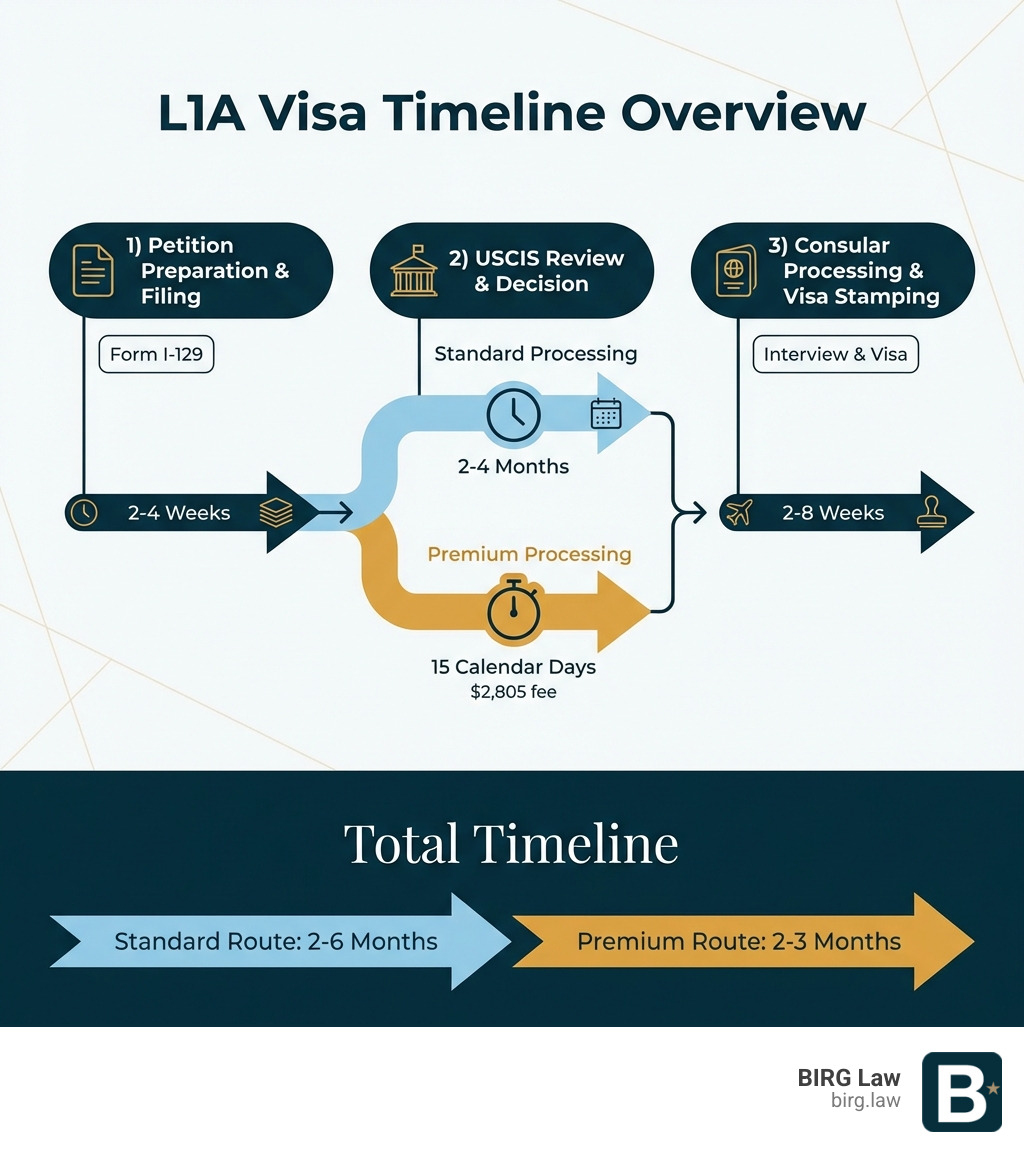
The L-1A visa timeline typically ranges from 2 to 6 months under standard processing, but can be expedited to as fast as 15 days with premium processing. Here’s what to expect:
Quick L-1A Visa Timeline Overview:
- Petition Preparation: 2-4 weeks (employer gathers documents and files Form I-129)
- USCIS Review (Standard): 2-4 months
- USCIS Review (Premium): 15 calendar days ($2,805 fee)
- Consular Processing: 2-8 weeks (after USCIS approval)
- Total Timeline: 2-6 months (standard) or as fast as 2-3 months (premium)
Moving to the United States for work involves patience — lots of it. The L-1A visa process can feel like navigating a labyrinth, with multiple government agencies, strict documentation requirements, and unpredictable delays. Whether you’re an executive planning to expand your company’s U.S. operations or a manager being transferred to an American office, understanding the realistic timeline is crucial for planning your move.
Several factors influence how long your L-1A visa will actually take. The workload at your specific USCIS service center matters. So does whether you’re opening a new U.S. office or joining an established one. The completeness of your petition, your country of origin, and whether you opt for premium processing all play significant roles in determining your timeline.
At Birg Law, we’ve guided countless executives and managers through the l1a visa timeline over our 30+ years of practice, helping clients steer complex cases from petition preparation through final visa issuance. We understand the frustrations of waiting and the importance of strategic planning to minimize delays.
Deconstructing the L-1A Visa Process: The Main Stages
The L-1A visa is a non-immigrant visa designed for executives and managers of international companies to transfer to a U.S. office. It’s a fantastic pathway for businesses looking to expand or strengthen their presence in the U.S. However, before packing your bags and dreaming of Chicago deep-dish pizza, understand the multi-stage process. The entire journey, from filing the initial petition to receiving the visa, typically involves two main phases: the U.S. portion handled by USCIS and the consular processing abroad.
For a deeper dive into the specifics of this visa category, we encourage you to explore our comprehensive guide: Understanding the L-1A Visa: Your Gateway to Expanding in the U.S.
Stage 1: Petition Preparation and Filing
This is where the magic begins, or at least the paperwork. The U.S. employer (or the foreign employer, if establishing a new office) initiates the process by gathering extensive documentation and filing a petition on behalf of the employee. This stage is critical, as any inaccuracies or omissions can lead to significant delays down the line. We recommend starting this phase at least 2-4 weeks before the intended filing date to ensure everything is perfect.
Key aspects of this stage include:
- Employer’s Role: The petitioning employer must demonstrate a “qualifying relationship” with the foreign company (e.g., parent, subsidiary, affiliate, branch) and prove they are “doing business” in the U.S. and at least one other country.
- Employee Qualifications: The employee must have worked for the foreign company for at least one continuous year within the three years immediately preceding their transfer to the U.S., in an executive or managerial capacity.
- Document Gathering: This is a meticulous process involving corporate documents, financial statements, organizational charts (showing both U.S. and foreign entities), detailed job descriptions for the executive/managerial role, and often a comprehensive business plan, especially for new U.S. offices.
- Filing Form I-129: The employer formally requests L-1A classification by filing Form I-129, Petition for a Nonimmigrant Worker, along with the required filing fees and all supporting evidence, with U.S. Citizenship and Immigration Services (USCIS).
Stage 2: U.S. Citizenship and Immigration Services (USCIS) Review
Once your carefully prepared petition is submitted, it lands on the desk of USCIS. This is the government agency responsible for adjudicating (approving or denying) the petition.
Here’s what happens during this stage:
- Petition Receipt Notice: USCIS will issue a receipt notice (Form I-797C) acknowledging receipt of your petition. This notice will include a receipt number, which you’ll use to track your case online.
- USCIS Service Centers: Petitions are processed at various USCIS service centers across the country. The processing time can vary significantly depending on the specific service center and its current workload.
- Adjudication: A USCIS officer reviews the petition and all supporting documents to determine if the employer and employee meet all eligibility requirements for L-1A classification.
- Approval Notice: If the petition is approved, USCIS issues an approval notice (Form I-797). This is a monumental step, but it’s not the final one!
- Request for Evidence (RFE): Sometimes, the USCIS officer may require additional information or clarification. They will issue a Request for Evidence (RFE), which can add weeks or even months to your L-1A visa timeline. Responding to an RFE promptly and comprehensively is crucial to avoid further delays or a denial.
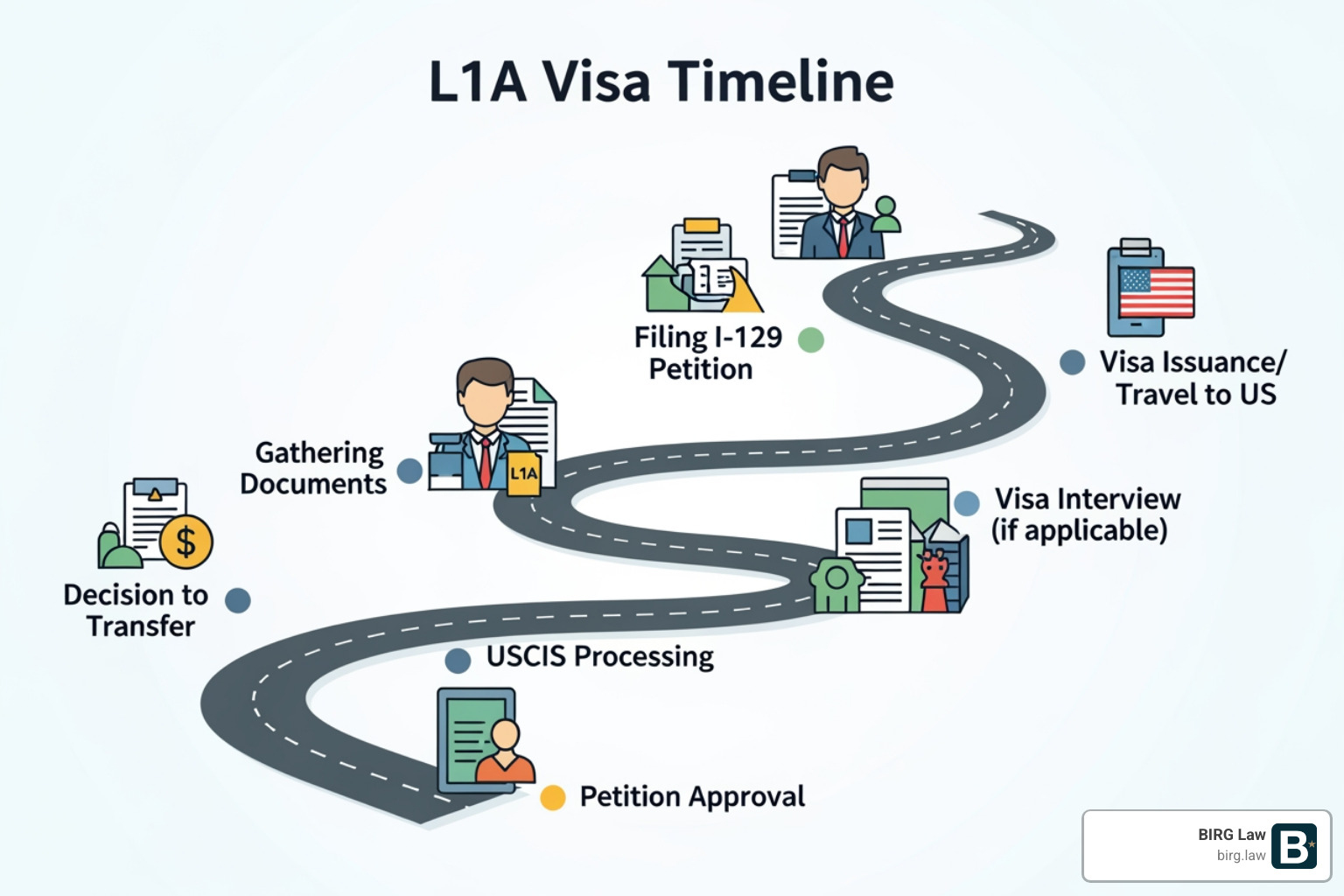
Stage 3: Consular Processing and Visa Issuance
After receiving USCIS approval, the focus shifts from domestic to international. This stage is managed by the Department of State (DOS) through U.S. embassies and consulates abroad.
The steps typically include:
- USCIS Approval: Once USCIS approves your I-129 petition, they forward the case to the National Visa Center (NVC).
- National Visa Center (NVC): The NVC acts as a liaison, collecting necessary fees and documents from the applicant (beneficiary) before scheduling a visa interview. You’ll generally receive notifications by email once your case is “documentarily complete.”
- Filing Form DS-160: The individual L-1A applicant must complete and submit the online Nonimmigrant Visa Application, Form DS-160.
- Visa Interview Scheduling: Once the NVC confirms all fees and documents are in order, they will work with the appropriate U.S. Embassy or Consulate to schedule a visa interview. Interview wait times can vary widely by location, typically ranging from 2-4 weeks, but can be longer in high-demand areas.
- Embassy or Consulate Interview: The applicant attends an in-person interview at the U.S. Embassy or Consulate in their home country. The consular officer will review the application, ask questions about the job, the company, and the applicant’s intent to return home after their temporary stay.
- Administrative Processing: In some cases, after the interview, the consular officer may require additional administrative processing (often indicated by a 221(g) notice). This can involve background checks or further security clearances and can add weeks, or even months, to the timeline.
- Visa Stamp: If approved, the consular officer will place an L-1A visa stamp in the applicant’s passport, allowing them to travel to the U.S. and seek admission. Passport return times typically range from 5-10 business days.
Standard vs. Premium Processing: How to Accelerate Your L-1A Visa Timeline
When it comes to the L-1A visa timeline, waiting is often the hardest part. Thankfully, USCIS offers options to either endure the standard queue or fast-track your petition for an additional fee.
Understanding the Standard L-1A Visa Timeline
For many, the standard processing route is the default. This means your Form I-129 petition will be processed in the regular order it was received by USCIS.
- Typical Duration: The USCIS review stage for an L-1A petition under standard processing typically takes anywhere from 2 to 4 months. When you factor in the petition preparation and subsequent consular processing, the entire L-1A visa timeline can stretch from 2 to 6 months under normal conditions.
- USCIS Service Center Workload: The exact duration depends heavily on the specific USCIS service center handling your case and its current workload. Think of it like traffic: some lanes move faster than others!
- Case Complexity: A straightforward petition with clear evidence might move quicker than a complex one, such as a “new office” petition which often receives greater scrutiny.
- Staying Informed: We always advise our clients to keep an eye on the official processing times. You can always Check current USCIS processing times on the USCIS website for the most up-to-date estimates for your form and service center.
The Premium Processing Express Lane
If time is of the essence, USCIS offers a “Premium Processing” service, essentially an express lane for your petition.
- Guaranteed Decision: For an additional fee, USCIS guarantees a decision on your Form I-129 petition within 15 calendar days. This decision could be an approval, a denial, or a Request for Evidence (RFE).
- Associated Cost: The fee for Premium Processing is currently $2,805. This is in addition to the standard filing fees for Form I-129.
- Expedited USCIS Stage Only: Premium Processing only expedites the USCIS adjudication of your Form I-129 petition. It does not speed up the subsequent consular processing stage (visa interview, administrative processing, visa stamping). So, while your petition might be approved in 15 days, you’ll still need to factor in time for the NVC and embassy/consulate.
- Who Should Consider It?: Companies with urgent transfer needs, such as those launching new projects or facing tight deadlines, often find the cost of Premium Processing a worthwhile investment to avoid operational delays.
You can find More on Premium Processing on the USCIS website.
Common Roadblocks: What Factors Can Delay L-1A Processing?
Even with meticulous preparation, the path to an L-1A visa can sometimes hit a snag. Various factors, both within USCIS and related to the applicant or consular process, can extend your L-1A visa timeline. Understanding these potential roadblocks can help you prepare and mitigate their impact.
USCIS-Side Delays
Sometimes, the delays aren’t about your application, but about the system itself.
- High Case Volume: USCIS service centers, like any government agency, experience fluctuations in their workload. High volumes of petitions can naturally lead to longer processing times for everyone.
- Administrative Processing: Beyond standard review, some cases may undergo additional administrative processing. This can be triggered by various factors, including security background checks, and can add weeks or even months to the timeline without clear explanations.
- Security Background Checks: All visa applicants are subject to security checks by various U.S. government agencies. While most are quick, some can become extended, especially if there are name commonalities or other flags.
- VIBE Program Checks: USCIS uses the Validation Instrument for Business Enterprises (VIBE) program to verify the existence and legitimacy of petitioning employers. While intended to streamline verification, sometimes issues with VIBE data can cause slight delays.
Applicant-Related Delays
Often, delays stem from issues within the application itself.
- Incomplete Documentation: The single biggest cause of delay is submitting an incomplete petition or one lacking sufficient supporting evidence. USCIS officers are thorough, and if something is missing, they will ask for it.
- Weak Evidence of Managerial Role: For L-1A, clearly demonstrating that the role is truly managerial or executive is paramount. If the evidence is ambiguous or suggests a specialized knowledge role (L-1B) or even a non-qualifying role, it will invite scrutiny and likely an RFE.
- New U.S. Office Petitions: These petitions, for companies establishing a new U.S. presence, face increased scrutiny. USCIS wants to ensure the new office is viable and that the L-1A role will truly be managerial or executive within one year of approval. This often requires a detailed business plan and financial projections, and any perceived weaknesses can lead to delays.
- Responding to RFEs: As mentioned earlier, a Request for Evidence (RFE) is a formal request from USCIS for more information. While it’s an opportunity to strengthen your case, it automatically adds significant time to your L-1A visa timeline (typically 30-90 days for response preparation, plus USCIS’s time to review the response).
Consular Processing Hold-Ups
Even after USCIS approval, the consular stage can present its own set of challenges.
- Embassy Interview Backlogs: U.S. embassies and consulates around the world have varying workloads. Some may have long wait times for interview appointments, impacting your overall timeline.
- Country-Specific Conditions: Political situations, natural disasters, or even public health crises in a particular country can temporarily close or reduce services at U.S. embassies, leading to delays.
- 221(g) Notices: Similar to RFEs from USCIS, a consular officer might issue a 221(g) notice asking for additional documents or administrative processing. This can prolong the decision-making process for weeks or months.
- Passport Return Time: Once the visa is approved, your passport needs to be processed and returned to you. While typically 5-10 business days, this can sometimes take longer, especially if third-party courier services are involved.
L-1A Variations and Extensions: What to Expect
The L-1A visa attorneys in Chicago offer flexibility, but it’s important to understand the nuances between different filing methods and how extensions work. This knowledge is key to managing your L-1A visa timeline effectively.
For businesses and individuals considering various immigration options, our firm provides comprehensive guidance on Business and Employment-Based Visas and Green Card pathways.
Individual vs. Blanket L-1 Petitions
The L-1 visa program offers two primary avenues for employers: individual petitions and blanket petitions. The choice significantly impacts the processing timeline, especially at the consular stage.
- Individual Petition: This is the standard route we’ve largely discussed, where an employer files a separate Form I-129 petition with USCIS for each individual employee they wish to transfer. This process requires USCIS approval before consular processing can begin.
- Blanket L Petition: This option is available to large, multinational employers who frequently transfer employees. Instead of filing individual petitions, eligible companies can establish the required intracompany relationship in advance by filing a single “blanket petition” with USCIS.
- Streamlined Process: Once the blanket petition is approved, individual employees can apply directly at a U.S. embassy or consulate with a completed Form I-129S, Nonimmigrant Petition Based on Blanket L Petition, along with other required evidence.
- Faster Consular Stage: This eliminates the need for prior individual USCIS approval, often dramatically speeding up the consular processing time. Consular processing under a blanket petition can sometimes be as quick as two weeks.
- Benefits for Multinational Employers: For companies with multiple U.S. offices and frequent transfers, a blanket petition is a game-changer, allowing for much faster deployment of key personnel. Eligibility typically requires an office in the U.S. doing business for one year or more, three or more domestic and foreign branches, and meeting certain thresholds (e.g., at least 10 L-1 approvals in the past 12 months, or U.S. subsidiaries with combined annual sales of at least $25 million).
L-1A Visa Extension Processing Timeline
An L-1A visa is not a one-and-done deal. It comes with specific initial validity periods and possibilities for extensions, all with their own timelines.
- Initial Stay Period:
- 1 Year for New Offices: If you are establishing a new U.S. office, your initial L-1A visa will typically be granted for a maximum of one year. This shorter period allows USCIS to reassess the viability of the new office and the continued need for an L-1A executive/manager.
- 3 Years for Established Offices: For transfers to existing, established U.S. operations, the initial L-1A visa is typically granted for up to three years.
- 2-Year Extensions: After the initial period, L-1A visas can be extended in increments of up to two additional years.
- 7-Year Maximum Stay: The total cumulative stay for an L-1A visa holder is typically seven years. Once this maximum is reached, the individual usually must spend at least one year outside the U.S. before being eligible for another L-1 or H visa.
- L-1A Extension Processing Timeline: The processing time for an L-1A extension (which involves filing a new Form I-129 petition) is similar to an initial petition, ranging from 2-4 months under standard processing, or 15 calendar days with premium processing.
- 240-Day Grace Period: A helpful provision for those awaiting an extension: if you file your L-1A extension petition before your current I-94 expires, you are generally authorized to continue working for the same employer in the same position for up to 240 days while your extension is pending. This prevents gaps in employment authorization and allows your L-1A visa timeline to flow more smoothly.
Frequently Asked Questions about the L1A Visa Timeline
Navigating immigration can bring up a lot of questions. Here, we address some of the most common inquiries regarding the L-1A visa timeline.
How does the L-1A timeline compare to the H-1B visa?
This is a frequent question, and the L-1A often comes out favorably in terms of processing speed and certainty for qualifying individuals.
- No Annual Cap & No Lottery System: Unlike the H-1B visa, which is subject to an annual cap and a highly competitive lottery system, the L-1A visa has no annual cap and no lottery. This means that if you meet the eligibility criteria, you can apply at any time of year without the uncertainty of selection. This alone makes the L-1A visa timeline far more predictable.
- Generally Faster Processing: In general, L-1 visas tend to have much faster processing times than other work visa categories, including the H-1B, especially when premium processing is used. The H-1B lottery itself adds months of waiting even before processing begins.
- Dual Intent: Both L-1A and H-1B are dual intent visas, meaning holders can pursue permanent residency (a green card) without jeopardizing their temporary nonimmigrant status.
- Specific Intracompany Requirement: The key difference lies in eligibility. The L-1A is specifically for intracompany transfers of executives and managers within a multinational company, while the H-1B is for individuals in specialized occupations sponsored by any U.S. employer.
How can I track my L-1A case and when should I inquire about a delay?
Staying informed about your case status is empowering. USCIS provides tools to help you do just that.
- USCIS Receipt Number: Once your Form I-129 petition is filed, USCIS will issue a receipt notice (Form I-797C) with a unique 13-character receipt number. This is your golden ticket for tracking.
- Check Your Case Status Online: You can easily check your case status online by entering your receipt number. This portal provides updates on your application’s progress. You can also sign in or create a USCIS account to see your estimated case timeline.
- Outside Normal Processing Times: USCIS has specific guidelines on when you can inquire about a delayed case. Generally, you can only inquire if your case is taking longer than what USCIS defines as “normal processing times” for your specific form and service center.
- 93% Completion Rule: For most forms, USCIS allows inquiries if your case is taking longer than the time it took them to complete 93% of adjudicated cases over the last six months. The USCIS processing times webpage has a tool where you can enter your receipt date to determine if you can contact them.
- Case Inquiry Tool: If your case falls outside the normal processing times, you can use USCIS’s online case inquiry tool to submit a service request. We always recommend checking the official USCIS processing times page before making an inquiry.
Does a “New Office” L-1A petition take longer?
Yes, generally, a “New Office” L-1A petition can take longer and is subject to increased scrutiny compared to petitions for established U.S. operations.
- Increased Scrutiny: When a foreign company is establishing its first U.S. office and transferring an L-1A executive or manager, USCIS wants to ensure the U.S. entity is viable and that the proposed managerial/executive role will materialize. This requires more extensive proof and a solid business plan.
- One-Year Initial Validity: As mentioned, new office L-1A visas are initially granted for a maximum of one year. This is a shorter period than the three years typically granted for established offices, indicating the higher level of review.
- Requires Detailed Business Plan: These petitions necessitate a robust business plan detailing the U.S. company’s operations, financial projections, organizational structure, and how it will support an executive or managerial position within one year of the petition’s approval. Any weaknesses in this plan can lead to RFEs and significant delays in the L-1A visa timeline.
- Slower Than for Established Offices: While premium processing can expedite the USCIS portion, the inherent complexity and heightened evidentiary requirements often mean that the overall process, including preparation and potential RFEs, is slower than for transfers to existing, well-established U.S. operations.
Charting Your Course for a Successful L-1A Journey
Navigating the L-1A visa timeline can feel like a marathon, not a sprint. However, with the right approach, you can significantly streamline the process and minimize unexpected detours.
- Strategic Planning: Start early. Understand each stage, anticipate potential challenges, and plan your application well in advance of your desired start date.
- Meticulous Preparation: Accuracy and completeness are king. Ensure every form is filled out correctly, and every piece of supporting documentation is robust and clearly demonstrates eligibility. Incomplete applications or weak evidence are the primary causes of delays.
- Professional Guidance: The L-1A visa category is complex, with nuanced definitions of “executive” and “manager” and stringent requirements for qualifying organizations. Consulting with an experienced immigration attorney can be invaluable. We can help you avoid common pitfalls, craft a strong petition, respond effectively to RFEs, and strategically use options like premium processing. Our expert team at Birg Law, serving clients in Northfield, Glencoe, Winnetka, Northbrook, and throughout the Chicago area, is here to explain the process for you.
Your journey to the U.S. is important, and we are here to help make it as smooth as possible. Contact Birg Law today to discuss your L-1A visa strategy and get a personalized timeline assessment for your Visa L-1A application.