



Understanding Asylum Credible Fear: Your First Critical Step Toward Protection
Asylum credible fear is the initial screening standard used to determine if an individual placed in expedited removal proceedings has a valid basis to pursue asylum or other protection in the United States. If you’re facing this process, here’s what you need to know right away:
Quick Facts About Credible Fear:
- What it is: A low-threshold screening showing a “significant possibility” you could establish asylum eligibility
- Who conducts it: USCIS asylum officers (over 60% of interviews are conducted by phone)
- What it requires: Evidence of past persecution or well-founded fear of future persecution based on race, religion, nationality, political opinion, or membership in a particular social group
- What it’s not: A final asylum decision—it only determines if you can proceed to a full hearing
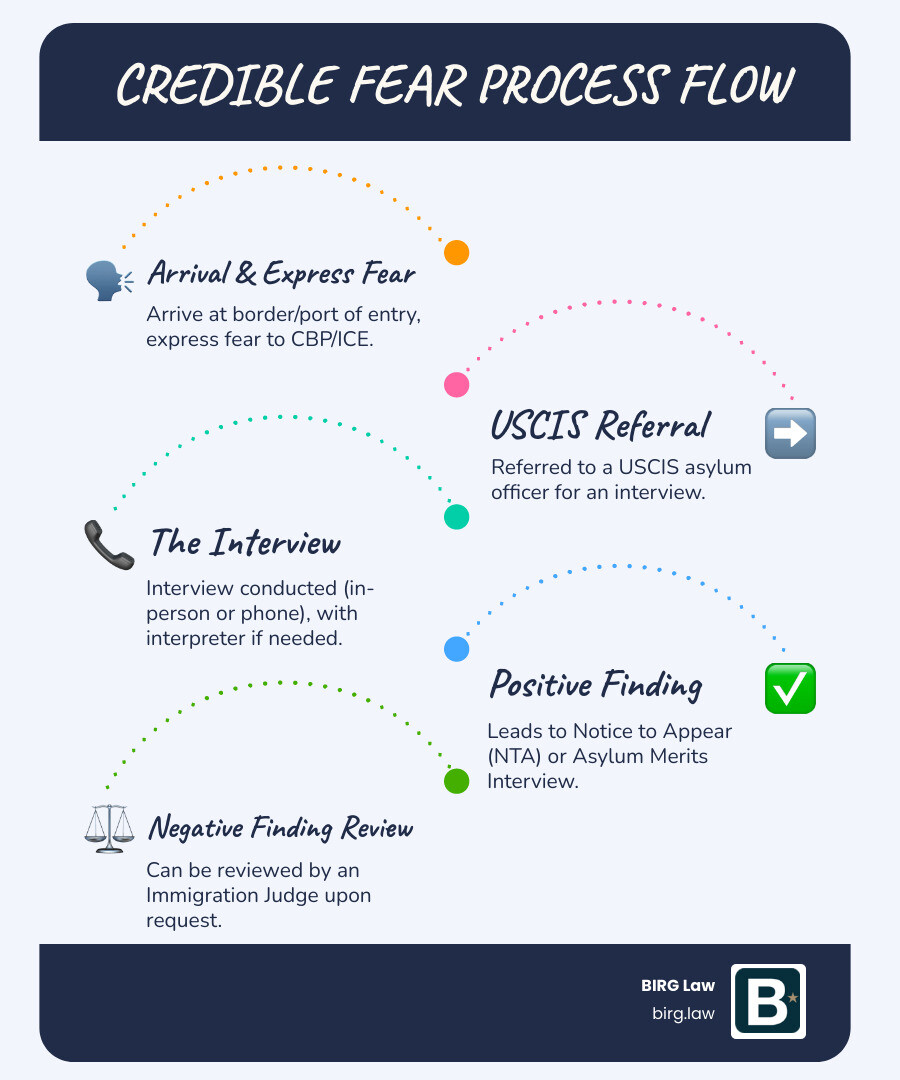
- If you pass: You receive a Notice to Appear before an immigration judge or an Asylum Merits Interview with USCIS
- If you fail: You can request review by an immigration judge within a limited timeframe
This screening interview happens when you arrive at a U.S. border or port of entry and express fear of returning to your home country. It’s designed as a safeguard—a way to ensure that people with legitimate protection claims aren’t immediately deported before they can present their case.
The stakes are extraordinarily high. Your testimony during this brief interview can determine whether you get the chance to apply for asylum or face immediate removal. Many applicants steer this process while detained, under significant stress, and without full understanding of the legal standards they must meet.
At BIRG Law, we’ve guided countless individuals through the asylum credible fear process, helping them understand their rights, prepare compelling testimony, and steer the complex legal landscape that follows a credible fear determination. Our three decades of immigration law experience have taught us that strategic preparation and clear communication are essential to success in these high-stakes screenings.
Understanding the Core Concepts of Fear-Based Claims
When we talk about asylum credible fear, we’re delving into a critical concept in U.S. asylum law. It’s the initial hurdle for individuals seeking humanitarian protection who find themselves in expedited removal proceedings. The entire purpose of this screening is to determine if there’s a “significant possibility” that you could establish eligibility for asylum or other forms of protection in a more formal setting. It’s a low screening standard, designed to filter out frivolous claims while ensuring genuine ones move forward.
The core of a fear-based claim rests on demonstrating past persecution or a well-founded fear of future persecution. This fear must be on account of specific protected grounds: your race, religion, nationality, political opinion, or membership in a particular social group. If your fear doesn’t fall into one of these categories, it generally won’t qualify for asylum.
We must also understand the difference between asylum credible fear and “reasonable fear.” While both are screening processes for individuals facing removal, they apply in different circumstances and have different legal standards. For a comprehensive overview of the process, you can refer to the Questions and Answers: Credible Fear Screening provided by USCIS.
What is the Definition of Asylum Credible Fear?
At its heart, asylum credible fear refers to a situation where an individual demonstrates a “significant possibility” that they could prove eligibility for asylum or withholding of removal if they were to have a full hearing before an Immigration Judge. In simpler terms, it’s a preliminary finding that your fear of returning to your home country is substantial enough to warrant further legal proceedings.
This determination is not a final decision on your asylum claim. Think of it as a gatekeeper. If you pass through this gate, you’re allowed to present your full case for asylum. If you don’t, you may face immediate removal. The legal standard for this is found in 8 CFR 208.30 legal standard, which outlines the procedures for these determinations. It’s considered a “low screening standard” because it’s meant to err on the side of caution, ensuring that potentially valid asylum claims are not dismissed prematurely.
Credible Fear of Persecution vs. Credible Fear of Torture
While both fall under the umbrella of asylum credible fear, there’s a distinction between fearing persecution and fearing torture, and this distinction impacts the type of protection you might ultimately receive.
- Credible Fear of Persecution: This means there’s a “significant possibility” you can establish eligibility for asylum. Asylum is a discretionary form of protection that, if granted, can lead to lawful permanent residency. The fear of persecution must be on account of race, religion, nationality, membership in a particular social group, or political opinion. The standard for asylum is proving a “well-founded fear,” which often translates to demonstrating a “one in ten chance” of persecution.
- Credible Fear of Torture: This means there’s a “significant possibility” that it is “more likely than not” you would be tortured if returned to your country. This higher standard applies to claims for protection under the Convention Against Torture (CAT). CAT protection, along with withholding of removal, is a mandatory form of protection. Unlike asylum, these protections do not lead to permanent residency, but they prevent your removal to a country where you face a high risk of torture or persecution (more than a 50% chance). Even if you have mandatory bars to asylum, you might still be eligible for withholding of removal or CAT protection if you can meet this higher “more likely than not” standard.
Credible Fear vs. Reasonable Fear Interviews
It’s easy to confuse these two terms, but they apply to different situations and have distinct legal standards:
| Feature | Credible Fear Interview | Reasonable Fear Interview |
|---|---|---|
| Applies to | Individuals in expedited removal proceedings, typically those who recently entered without authorization or with fraudulent documents. | Individuals with prior removal orders who re-entered the U.S., or those convicted of certain aggravated felonies. |
| Legal Standard | “Significant possibility” of establishing asylum, withholding of removal, or CAT eligibility. | “Reasonable possibility” of persecution or torture. This is a higher standard than “significant possibility.” |
| Purpose | To screen for potential asylum claims before immediate removal. | To screen for potential withholding of removal or CAT claims for individuals with existing removal orders. |
| Outcome (if positive) | Referral to an Immigration Judge for formal removal proceedings (where asylum can be sought) or an Asylum Merits Interview with USCIS. | Referral to an Immigration Judge for consideration of withholding of removal or CAT protection. |
The key takeaway is that a reasonable fear interview is for individuals who have already been ordered removed or have certain serious criminal convictions, while a credible fear interview is generally for those encountering expedited removal for the first time. The “reasonable possibility” standard is more stringent, reflecting the individual’s prior interaction with the immigration system.
Navigating the Asylum Credible Fear Process Step-by-Step
Once you express a fear of returning to your home country to a Customs and Border Protection (CBP) or Immigration and Customs Enforcement (ICE) officer, you initiate the asylum credible fear process. This is a crucial step, and knowing what to expect can significantly reduce stress and improve your chances of a positive outcome.

DHS will then refer you to a USCIS asylum officer for an interview. You may be detained during this process. Due to resource constraints, a significant portion of these interviews—over 60%, in fact—are conducted telephonically. While this can be challenging, the interview itself is designed to be non-adversarial. The asylum officer’s role is not to be an opponent, but to elicit the facts of your claim.
Who Conducts the Interview and What Are Your Rights?
Your asylum credible fear interview will be conducted by a USCIS asylum officer. These officers are trained to identify potential asylum claims. During this high-stakes moment, remember your rights:
- Right to Consult: You have the right to consult with a person of your choosing, such as an attorney or a trusted representative, prior to and during the interview. While the government doesn’t pay for this counsel, we strongly recommend seeking legal guidance.
- Waiting Period: DHS is supposed to provide you with an orientation to the credible fear process, a list of free or low-cost legal service providers, and a waiting period of at least four hours before the interview. This time is intended for you to gather your thoughts and, ideally, consult with legal counsel. At BIRG Law, we understand that finding legal assistance quickly is paramount, and we are committed to providing legal defense in Immigration Court for individuals navigating these urgent situations.
- Right to an Interpreter: If you cannot effectively communicate in English, a qualified interpreter will be provided at no cost to you. Ensure you understand the interpreter and can clearly convey your story.
- Right to Review: At the end of the interview, the asylum officer will summarize the material facts of your statement and their determination. You have the right to review this summary and make any corrections or additions.
What to Expect During the Interview
The asylum credible fear interview is your opportunity to articulate why you fear returning to your home country. The asylum officer will cover several key domains:
- Your Background: Questions about your identity, nationality, family, and history.
- Details of Harm or Fear: This is where you describe any past persecution you have suffered or why you fear future persecution. Be as specific as possible about dates, locations, perpetrators, and what happened to you.
- Reasons for Fear: You must connect your fear to one of the five protected grounds: race, religion, nationality, political opinion, or membership in a particular social group. For example, if you fear violence because of your political activism, explain your political opinion and how it led to threats.
- Questions about Mandatory Bars: The asylum officer will ask questions to determine if any mandatory bars to asylum might apply to your case. While these bars aren’t decided during the credible fear interview, they will be noted for later proceedings. Examples include having committed a particularly serious crime or having persecuted others.
- Your Testimony is Key: Your credible testimony alone can be sufficient to establish a credible fear. While corroborating evidence is helpful, your truthful and consistent account is paramount.
We understand that recounting traumatic experiences can be incredibly difficult, especially in a formal setting. Our team at BIRG Law is here to help you prepare, ensuring you can clearly and confidently present your story.
What Happens After a Positive Credible Fear Finding?
Congratulations! If an asylum officer determines you have a asylum credible fear, it means you’ve successfully passed the initial screening and will have the opportunity to pursue your asylum claim further. The exact path forward can vary:
- Notice to Appear (NTA): Often, you will be issued a Notice to Appear (NTA) before an Immigration Court. This initiates formal removal proceedings, where you can then file your Form I-589 (Application for Asylum and for Withholding of Removal) and present your full case to an Immigration Judge.
- Asylum Merits Interview (AMI) with USCIS: Under a 2022 rule, USCIS asylum officers can now, in some cases, retain jurisdiction over your asylum application for an Asylum Merits Interview (AMI). In this scenario, the written record of your positive credible fear determination is treated as your asylum application, and you won’t need to file a separate Form I-589 immediately. The AMI is a non-adversarial interview designed to determine your eligibility for asylum, withholding of removal, or CAT protection. If asylum is not granted during the AMI, your case is typically referred to an Immigration Judge for “streamlined” removal proceedings.
- Potential for Parole from Detention: If you are detained and receive a positive credible fear finding, you may be eligible for parole. ICE has specific guidelines for paroling arriving aliens with favorable credible fear determinations. This involves demonstrating you are not a flight risk or a danger to the community. You may also have the opportunity for a bond re-determination hearing before an Immigration Judge.
Outcomes, Reviews, and the Role of the Immigration Judge
The asylum credible fear process, while an initial screening, has profound implications for your future. Whether the asylum officer makes a positive or negative determination, there are clear next steps and opportunities for review.

It’s worth noting the importance of legal representation throughout this entire process. Among pending asylum cases, 62% of individuals were represented, and among completed asylum cases, this figure rose to 80%. This highlights how crucial legal guidance can be in navigating these complex proceedings.
What Happens After a Negative Asylum Credible Fear Finding?
If an asylum officer determines that you do not have a asylum credible fear, it’s certainly a disheartening moment, but it’s not necessarily the end of the road. You have a crucial right:
- Request for Review: You can request that an Immigration Judge (IJ) review the asylum officer’s negative determination. This request must be made promptly.
- Immigration Judge Review: The IJ’s review is conducted “de novo,” meaning they will look at your case with fresh eyes, considering all the evidence and your testimony. They will review the asylum officer’s record and may hear additional testimony from you.
- Upholding the Negative Finding: If the Immigration Judge concurs with the asylum officer’s negative determination, their decision is generally final and cannot be appealed further. In this scenario, ICE may proceed with your removal from the U.S.
- Overturning the Negative Finding: If the Immigration Judge finds that you do indeed possess a credible fear, they will overturn the asylum officer’s negative finding. In this positive outcome, your case will then be referred to DHS for further proceedings, typically placing you in formal removal proceedings before an Immigration Judge, where you can apply for asylum.
The Immigration Judge’s Role in Reviewing Determinations
The Immigration Judge plays a vital role as a check and balance in the asylum credible fear process. When you request a review of a negative determination, the IJ will:
- Review the Asylum Officer’s Record: The IJ will examine all documentation from your credible fear interview, including the asylum officer’s notes and your written statement.
- Hear Your Testimony: The IJ will give you an opportunity to present your case, often asking questions to clarify your fears and the basis for your asylum claim. This de novo review means the judge isn’t just checking for errors but making their own determination based on the evidence.
- Concur or Vacate: Based on their review, the IJ will either concur with the asylum officer’s negative finding (meaning they agree you don’t have a credible fear) or vacate it (meaning they disagree and find that you do). If the IJ finds credible fear, you will then be placed in formal removal proceedings, giving you the chance to apply for asylum in full.
The Broader Legal Landscape: Rules and Challenges
The asylum credible fear process doesn’t exist in a vacuum; it’s part of a broader, changing legal landscape shaped by legislation, court decisions, and executive actions. The authority for expedited removal, which triggers the credible fear screening, comes from the Immigration and Nationality Act (INA) section 235(b)(1)(A). This process was significantly expanded by the Illegal Immigration Reform and Immigrant Responsibility Act (IIRIRA) of 1996, specifically to address concerns about individuals potentially eligible for asylum being removed without a proper hearing.
Over time, the screening process has evolved. For instance, a 2022 rule now allows USCIS asylum officers to adjudicate asylum applications directly after a positive credible fear determination in some cases, rather than always sending them to an Immigration Judge. Despite these changes, the system faces systemic challenges, including long wait times. The backlog in U.S. immigration courts continues to reach all-time highs, with over 3.7 million open removal cases as of January 31, 2025. Such delays impact everyone, and we advocate for Immigration Policy Reforms that can create a more efficient and humane system.
How the “Circumvention of Lawful Pathways” Rule Impacts You
A significant recent development affecting asylum credible fear is the “Circumvention of Lawful Pathways” (CLP) rule. This rule, which remains in effect due to a stay issued by the Ninth Circuit Court of Appeals, presumes that individuals who enter the U.S. through the southwest land border without using a lawful pathway (such as an appointment via the CBP One app) are ineligible for asylum.
This rule creates a presumption of asylum ineligibility during your credible fear interview. While it doesn’t automatically bar you, it means you’ll need to demonstrate an exception to the rule or rebut this presumption. For example, if you were unable to access or use the CBP One app, you might be able to argue an exception. The goal of this rule is to encourage individuals to use “lawful, safe, and orderly pathways” to enter the U.S. You can find more details about this rule in The CLP rule in the Federal Register. This policy has effectively raised the bar during the credible fear interview for many seeking protection at the border.
Mandatory Bars and Border-Specific Rules
Beyond the CLP rule, there are several mandatory bars that can prevent someone from being granted asylum or even withholding of removal, even if they establish a asylum credible fear. While asylum officers don’t make final decisions on these bars during the credible fear interview, they will note if they appear to apply. These include:
- Persecution of Others: If you have persecuted others in the past.
- Particularly Serious Crime: If you have been convicted of a particularly serious crime.
- Terrorist Activity: If you have engaged in or supported terrorist activity.
- Danger to U.S. Security: If you are deemed a danger to the security of the United States.
- Firm Resettlement: If you have been “firmly resettled” in another country before coming to the U.S.
Additionally, specific rules apply at certain borders. For instance, the U.S.-Canada Safe Third Country Agreement affects asylum claims made at the U.S.-Canada border. Under this agreement, individuals attempting to cross into the U.S. from Canada may be returned to Canada without an asylum interview if they don’t qualify for an exception. To determine this, they must first go through a Threshold Screening Interview to establish eligibility for an exception to the agreement. This means that the path to protection can vary significantly depending on where and how you enter the country.
Frequently Asked Questions about Credible Fear
Navigating the asylum credible fear process can be overwhelming, filled with legal jargon and high stakes. Here, we address some of the most common questions our clients have.
Who is subject to expedited removal and the credible fear process?
The asylum credible fear process is primarily for individuals placed in expedited removal proceedings. This typically includes:
- Arriving Aliens: Individuals who arrive at a U.S. port of entry without proper travel documents, or with fraudulent documents.
- Apprehended Near the Border: Individuals apprehended by Border Patrol within 100 miles of the U U.S. land border and within 14 days of entry who have not been admitted or paroled.
- Other Inadmissible Aliens: Certain individuals found inadmissible under specific sections of the Immigration and Nationality Act (INA), such as those who misrepresented facts to gain admission.
This process acts as a crucial safeguard. It ensures that even if you are subject to expedited removal, you won’t be immediately deported if you have a legitimate fear of persecution or torture.
How long does the asylum process take after passing a credible fear interview?
Passing your asylum credible fear interview is a significant step, but it’s just the beginning of what can be a very long journey. The asylum process can take years to conclude due to substantial backlogs in immigration courts and USCIS.
For instance, national statistics show that individuals with an immigration court case who were ultimately granted relief in FY 2024 waited more than 1,283 days on average for that outcome. The backlog in U.S. immigration courts continues to reach all-time highs, with over 3.7 million open removal cases as of January 31, 2025. These delays can be frustrating and challenging, but having a clear strategy is essential. At BIRG Law, we help clients understand these timelines and develop a resilient approach through The BIRG Method.
What are the main criticisms of the credible fear screening process?
While designed as a humanitarian safeguard, the asylum credible fear screening process faces significant criticisms:
- High-Stakes Interviews in Difficult Conditions: Many interviews are conducted telephonically (over 60%), often in detention facilities that are not conducive to clear communication. Individuals, often traumatized, are expected to articulate complex legal arguments under immense pressure.
- Lack of Legal Representation: Detained individuals are nearly five times less likely to secure legal counsel than those not in detention. This disparity significantly impacts their ability to steer a complex legal system, even during this initial screening.
- Complex Legal Standards for Traumatized Individuals: Asylum officers may expect applicants to be familiar with legal jargon, such as the nuances of “particular social group,” which is unrealistic for individuals who are not lawyers and may have limited education. The traumatic repercussions from their journey or detention can make it difficult for individuals to recall and articulate their experiences clearly.
- Inconsistent Application of Rules by Officers: There have been criticisms that some CBP officers do not consistently ask individuals if they have a fear of returning or do not refer them for a credible fear interview, even when their statements suggest a potential asylum claim. This inconsistency can lead to individuals with legitimate claims being denied the opportunity to be heard.
These challenges underscore the importance of seeking legal assistance from experienced immigration attorneys.
Conclusion
Navigating the asylum credible fear process is undoubtedly one of the most critical and challenging initial steps for individuals seeking protection in the United States. As we’ve explored, it’s a complex, legally nuanced screening that determines whether you get the chance to pursue your asylum claim further. From understanding the difference between persecution and torture, to knowing your rights during an interview, and comprehending the impact of evolving rules like the Circumvention of Lawful Pathways, every detail matters.
The stakes are incredibly high, and the journey can be long, often marked by significant wait times and systemic challenges. However, passing your asylum credible fear interview is a pivotal achievement, opening the door to the next stage of your fight for safety and a new life.
At BIRG Law, we believe that having a strategic approach and expert legal guidance is vital for success. Our dedicated team is committed to providing compassionate and effective legal support to individuals navigating the asylum process. If you or someone you know is facing these challenges, don’t face them alone. Let us help you develop robust Immigration Strategies custom to your unique situation.
Get help with your immigration case today, and let us guide you toward a more secure future.