L-1 visa lawyers in Chicago
L-1 Intracompany Transfer Visa for executives and managers
We go through your case, find the weak spots and show you the shortest path.
An entrepreneur has two legal paths to the U.S.
Which one is yours comes down to one thing: do you already run an operating company?
- L-1A visa. You already run an operating company somewhere in the world, and you open a U.S. office of it.
- E-2 visa. You start or buy a business in the U.S. Your experience, education and profession don’t matter. Starting or buying a U.S. business? See the E-2 visa.
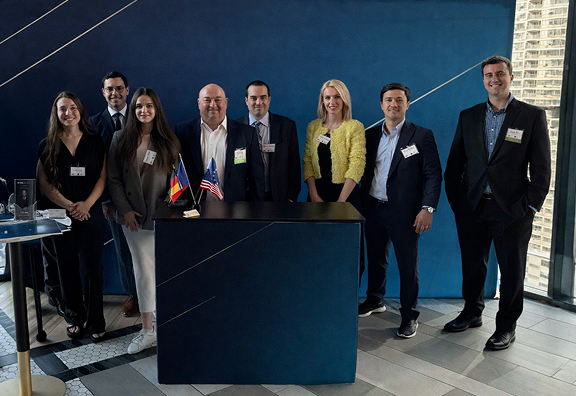
Your case is handled by immigration attorney Yuri Birg and his team in Chicago, with 30 years of practice.
L-1A: open a U.S. office of your company and transfer there
The L-1A covers your spouse and your children under 21, and you can work from day one.
It’s for executives and managers of a company that’s already operating, in Ukraine, Kazakhstan, Moldova, Europe or anywhere else. You open a related company in the U.S. and move to run it.
Citizenship. It doesn’t matter. No treaty with the U.S. is needed; what counts is the company.
Who it fits. An executive or manager of the parent company who is opening a U.S. branch.
What the L-1A asks for
- A qualifying parent, branch, subsidiary or affiliate relationship between the companies.
- One continuous year of work for the company abroad within the last three years.
- An executive or managerial role, both abroad and in the U.S.
- A business plan with a financial analysis for the U.S. company, including how it’s funded.
Executive or manager. An executive makes major decisions with limited oversight. A manager supervises staff or runs a department, function or other part of the organization. In practice USCIS expects an executive to manage a hierarchy, and we look for at least three employees under the role.
Opening a new U.S. office. The company has to secure premises, and the U.S. office has to be able to support an executive or managerial role within one year of approval. The business plan is expected to show about three hires within roughly a year. New-office petitions get closer review, and the first approval is for one year; a transfer to an established U.S. office gets up to three years. Extensions come in two-year steps, up to seven years in total.
Family. Your spouse and unmarried children under 21 get L-2 status for the same period. Since November 12, 2021, L-2 spouses are authorized to work automatically. Children can study but not work.
Green card. The L-1A leads directly to a green card through the EB-1C category, which doesn’t need labor certification.
L-1B for specialized knowledge. If your role isn’t executive or managerial but you have specialized knowledge of the company’s products, services, techniques, equipment or management, the L-1B may fit. It’s normally granted for three years, or one year for a new office, and can be extended up to five years in total.
Read more: How Long Does an L-1A Visa Really Take? and our investment and business immigration page.
More details come at the consultation: leave a request, and we’ll contact you to talk through your individual plan for moving to the U.S.
How is the L-1A different from the E-2?
The short version:
- Citizenship. L-1A: any. What counts is the company, not the passport. E-2: a treaty country, such as Ukraine, Kazakhstan, Moldova, Georgia, Armenia, Azerbaijan, Kyrgyzstan, Israel and most EU countries.
- What you need. L-1A: an operating company abroad and one year as its executive or manager. E-2: an investment in a U.S. business that you run.
- Visa term. L-1A: 1 year for a new U.S. office, up to 3 years for an established one. E-2: 2 years at a time.
- Longest stay. L-1A: up to 7 years, then a green card through EB-1C. E-2: no limit. It renews as long as the business runs.
- Path to a green card. L-1A: built in, with dual intent and then EB-1C. E-2: not built in. EB-1C, EB-2 NIW or EB-5 may work later.
- Who decides. L-1A: USCIS decides the petition first, then the consulate interviews you. E-2: a U.S. consular officer, or USCIS if you change status inside the U.S..
- Government fees. L-1A: $1,700 to $5,655, depending on company size and premium processing. E-2: $315 per applicant, and possibly another $250.
The same for both. No annual quotas and no lottery. Your spouse can work automatically by status, with no separate permit. Children under 21 move with you and go to school.
Government fees as of September 15, 2026. We quote our own fees individually after the consultation.
Build your individual plan
Book a consultationSix steps: from the first call to landing in the U.S. with a valid visa
How your case runs.
- Strategy consultation. Your story, your company, your family. We check whether the L-1A fits, or the E-2, or a mix of the two. If nothing fits yet, we tell you plainly. You and an attorney, 30 to 45 minutes.
- Structure and plan. Our attorneys review your documents and talk through the next steps with you: the U.S. company, how it’s owned by and tied to your company abroad, how it’s funded, the lease, and a five-year business plan with staffing. Birg Law and your accountant, 3 to 8 weeks.
- Filing. The company files Form I-129 with USCIS, describing the executive or managerial role, with the corporate evidence and the fees. With premium processing, USCIS decides within 15 business days. USCIS publishes current processing times at egov.uscis.gov/processing-times.
- Consular interview. After approval you complete the DS-160 and go to the interview in person, with your family and the full L-1 document set. We prepare you for it in advance. Ukrainian citizens apply in Warsaw or Krakow; everyone else at the U.S. consulate in their own country.
- Arrival. Your passport is stamped at entry, your spouse can start work without a separate permit, and your children start school. Our consultants help you settle in. Birg Law, Chicago, stays with you.
- You live and grow your business in the U.S. Your U.S. office operates here, and you and your family are in the U.S. legally. The L-1A extends in two-year steps, and EB-1C is the route to a green card.
Yuri Birg and team: 30 years of legal practice in the U.S.
Yuri Birg founded Birg Law and has handled immigration cases for more than 30 years.
The firm handles L-1, E-2, O-1, EB-1, EB-2 NIW and EB-5 cases for entrepreneurs across the country. The approach the firm calls The BIRG Method starts with strategy: it takes into account how USCIS and the U.S. embassies train their officers and review cases, and the firm hires former USCIS and embassy staff who decided cases like these themselves.
We speak your language. Consultations and documents in English, Russian and Ukrainian. The Chicago office also speaks Spanish.
Who signs. Your petition is signed by a licensed U.S. attorney, who also represents you on Form G-28.
Build your individual plan
Tell us about your capital or your company. We'll tell you straight whether the L-1A fits you, or the E-2, and what it will take.
Katalina will answer your questions and set up a meeting to discuss your immigration case.
Our offices
833.579.9989
312.380.0570 (Se habla español)
Send an email
[email protected]
Katalina will answer your questions and set up a meeting to discuss your immigration case.
Our offices
One Northfield Plaza, Suite 502, Northfield, IL 60093
641 W. Lake Street, Suite 400, Chicago, IL 60661
218 N. Lee Street, 3rd Floor, Alexandria, VA 22314
16360 Park Ten Place, Suite 115, Houston, Texas 77084
312.380.0570 (Se habla español)
Send an email
[email protected]